Intellectual property lawyer in France
Protect. Contract. Enhance.

Trademarks, creations, software, inventions: tell our intellectual property lawyer in France what your business needs to protect.
Go to the formIn the media
View the videos and their transcriptsVideos

Discover our know-how in intellectual property.











Kohen Avocats, Paris 17
Intellectual property: what really gives an asset its value
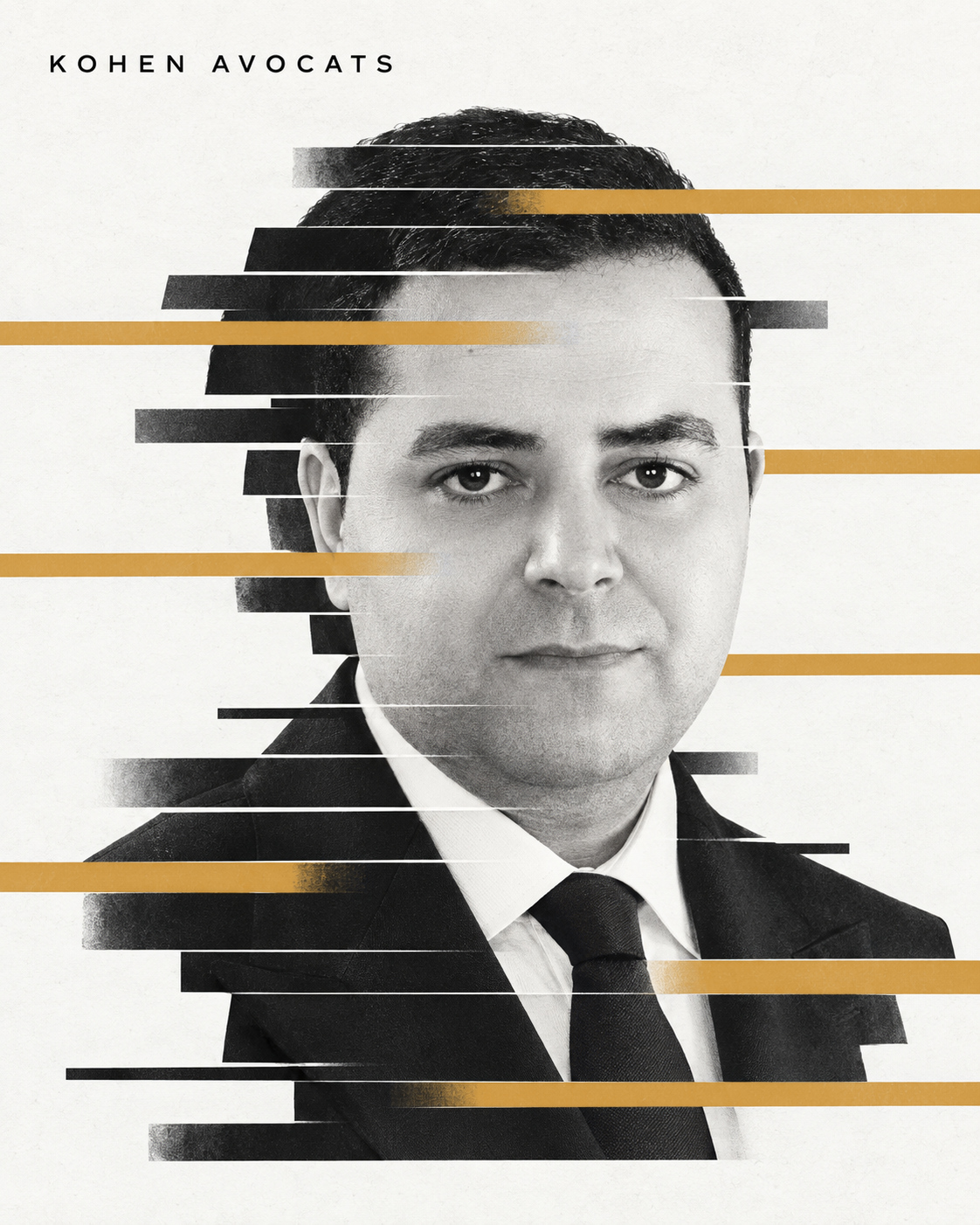
Trademarks, creations, inventions · Paris 17th arrondissement
What an intellectual property lawyer in Paris does
- Paris Bar
- Intellectual property
- Firm in Paris 17th
Lawyer at the Paris Bar: inventory of rights, assignment and licence agreements, contributions in kind, registrations with the registers.
Trademark rights arise from registration, which lasts ten years and is renewable without limit (Article L. 712-1 of the French Intellectual Property Code). Copyright, by contrast, arises from creation alone, and neither an employment contract nor a commissioning contract transfers it to the business (Article L. 111-1). Software written by an employee in the course of their duties is an exception, as the economic rights in it vest in the employer (Article L. 113-9). The firm therefore starts from a simple question: who holds each right the business exploits, and can it prove that to a buyer, a banker or a judge?
Send us the documents you have, even if incomplete: the firm will sort them and tell you what is missing, on +33 6 46 60 58 22.
Official profile in the directory of French lawyers (CNB)Firm at 11 rue Margueritte, 75017 Paris
Protect: choose the right title
A registered trademark, a registered design, a patent granted for twenty years from filing (Article L. 611-2): each asset calls for its own title, and copyright has to be proved because there is no register.
Contract: set out each right in writing
An assignment of copyright must mention each assigned right separately and define its field of use, place and duration (Article L. 131-3).
Enhance: record in order to enforce
An assignment, licence or pledge of a trademark can be relied on against third parties only once recorded in the National Trademark Register (Registre national des marques) (Article L. 714-7).
Key levers
Take inventory, put in writing, record, exploit
Four rules determine what a business's intellectual property portfolio is really worth.
- Exploiting a creation is not enough to own it: a company that had granted another company an implied assignment of its economic rights lost the right to sue, the Court of Cassation approving the judges for holding that “the ownership of the author's economic rights in the creations was a condition for the admissibility of an infringement action in respect of those rights” (our translation) (Cass. 1re civ., 28 January 2026, No. 24-11.394).
- A mission invention belongs to the employer, who may assign it, because “No provision prevents the latter from assigning that right to a third party” (our translation) (Cass. com., 5 January 2022, No. 19-22.030). Conversely, the mere purchase of the intangible assets of a company in liquidation “does not confer on the assignee the status of successor in title to the employer” (our translation) (Cass. com., 31 January 2018, No. 16-13.262), a solution unfavourable to the buyer.
- A transfer of the whole business carries the trademark with it, unless otherwise agreed (Article L. 714-1), but not the contracts surrounding it: “The sale of a business that includes the transfer of ownership of rights in trademarks does not, unless the deed of sale provides otherwise, entail the transfer of the selective distribution contract for products bearing those trademarks” (our translation) (Cass. com., 18 February 2026, No. 23-23.681).
- Registration determines enforceability against third parties: for a trademark included in a business that was sold, the Court of Cassation held that “failure to register within the period laid down by that provision results, not in the nullity of the trademark assignment, but in the security being unenforceable against third parties” (our translation) (Cass. com., 26 June 2024, No. 23-11.020); the provision now provides for unenforceability (Article L. 143-17 of the French Commercial Code).
A dormant trademark is lost: a proprietor who, without proper reason, lets five years pass without genuine use risks revocation (Article L. 714-5), and the Court of Cassation requires the court hearing the case to examine the sub-categories of goods actually exploited (Cass. com., 14 May 2025, No. 23-21.296).
Your documents
What to gather in order to map the rights
The quality of the inventory determines the value you can defend before a buyer, an investor or a licensee.
Position A
Company holding the rights
- Registration certificates and renewals (INPI, EUIPO, WIPO)
- Employment, service and commissioning contracts for the creations
- Dated evidence of use of each trademark, product by product
- Licences, assignments, pledges and proof of registration
Position B
Buyer, investor or licensee
- List of titles and chain of rights from the creator
- Extracts from the trademark and patent registers
- Oppositions, formal notices and pending disputes
- Confidentiality agreements and measures protecting trade secrets
Common mistakes: registering the trademark in the name of the company director rather than the company that exploits it; having a logo, website or software created by a service provider without a written assignment; signing a licence without recording it.
The firm also draws on:
- National Trademark Register
- National Patent Register
- Confidentiality agreements
- Contributions appraiser
The method
How the firm supports you
The order never changes: know what you hold before assigning it, licensing it or contributing it.
Step 1
Inventory and ownership
Review of titles, contracts and evidence of creation; a table of the rights, their holders and their expiry dates.
Step 2
Regularisation
Written assignments of commissioned creations, missing filings, transfer into the company's name of titles filed by a third party or by the director.
Step 3
Tailored contract
Assignment, exclusive or non-exclusive licence, contribution to a company, confidentiality agreement, each limited by its duration, territory and purpose.
Step 4
Recording and monitoring
Recording in the registers, renewal calendar, building the evidence of use, monitoring of competing filings.
Benchmarks: trademark ten years, renewable; patent twenty years from filing; design five years, extendable up to twenty-five (Article L. 513-1); copyright for the author's lifetime and seventy years after their death (Article L. 123-1).
The timetable
The stages of an intellectual property transaction
From inventory to registration, with indicative timings depending on the portfolio.
Inventory
Weeks 1-2. Titles, contracts, evidence of creation and use, renewal dates.
Regularisation
Weeks 2-4. Missing assignments of rights, additional filings, transfers of titles.
Negotiation
Depending on the transaction. Price or royalty, warranties, exclusivity, territory, fate of improvements.
Signing
Written deed, required on pain of nullity for the assignment of a trademark or a patent (Article L. 613-8).
Recording
After signing. National Trademark Register or National Patent Register, to make the deed enforceable against third parties.
Monitoring
Every year. Renewals, evidence of use, monitoring of new trademark applications.
The checks
What the firm checks before you sign
No assignment, licence or contribution without first validating these points.
- Actual holder of each title and each creation, complete chain of rights.
- Contents of the assignment: rights assigned, scope, purpose, place, duration.
- Genuine use of each trademark for the goods covered, dated evidence.
- Employee inventions: inventive mission, notification, additional remuneration.
- Registrations in the registers, pledges and licences already granted.
- Trade secrets: information protected and protective measures taken.
Summary
Situation, risk, act, decision
The most common decisions to be made on an intellectual property portfolio.
Situation
Logo, website or software created by a service provider
Main risk: A company that exploits a work without owning it.
Preferred step: Written assignment compliant with Article L. 131-3.
Recommended decision: Regularise before any fundraising or sale.
Situation
Invention developed by an employee
Main risk: Dispute over ownership or a claim for remuneration.
Preferred step: Classification of the invention under Article L. 611-7.
Recommended decision: Inform the employee and set the additional remuneration.
Situation
Trademark filed in the name of the director
Main risk: An asset outside the balance sheet of the company that exploits it.
Preferred step: Written assignment or licence, then recording.
Recommended decision: Choose between assignment and licence before the transaction.
Situation
Sale of the business or the company
Main risk: Licences and contracts linked to the trademarks not transferred.
Preferred step: Express clause for each contract and each title.
Recommended decision: Record the assignment with the INPI without delay.
Situation
Trademark little used for several years
Main risk: Revocation action by a competitor.
Preferred step: Building the evidence of use, product by product.
Recommended decision: Resume use or refile with an adjusted specification.
Situation
Know-how passed to a partner
Main risk: Disclosure without legal protection.
Preferred step: Confidentiality agreement and secrecy measures.
Recommended decision: Document the measures before any communication.
Frequently asked questions
Your questions: a business's intellectual property
Why consult an intellectual property lawyer before any dispute?
Because the value of a trademark, a piece of software or an invention depends less on its quality than on the strength of the chain of rights. A business that exploits a creation without owning it can neither usefully assign it, nor give it as security, nor defend it. The Court of Cassation reiterated this in approving a court of appeal for having held that “the ownership of the author's economic rights in the creations was a condition for the admissibility of an infringement action in respect of those rights” (our translation) (Cass. 1re civ., 28 January 2026, No. 24-11.394): the company that had implicitly assigned its rights to another company no longer had standing to sue.
Acting early serves three purposes. It identifies the right title for each asset, drafts the contracts that transfer or license the rights, and then has those deeds recorded in the registers so that they can be relied on against third parties. The firm examines these points before a fundraising, a sale of a business, the arrival of an industrial partner or the signing of a licence, which are the moments when a buyer or an investor will ask for proof of each right.
How can I find out which intellectual property rights my business really holds?
The inventory starts with registered titles: trademarks registered with the INPI, the European Union Intellectual Property Office or the WIPO, designs, patents. Trademark rights arise from registration (Article L. 712-1), so the name of the applicant shown in the register matters as much as the sign itself.
Next come creations without a register. Copyright belongs to the author by the sole fact of creation, and the existence of an employment or service contract does not change this (Article L. 111-1). Unless proven otherwise, the author is presumed to be the person under whose name the work is disclosed (Article L. 113-1). Software written by employees and mission inventions follow their own rules, which favour the employer.
Finally, some information qualifies as a trade secret where it is not readily accessible, has commercial value and is subject to reasonable protective measures (Article L. 151-1 of the French Commercial Code). For each asset, the firm checks the holder, the proof and the expiry date.
An employee created software or an invention: does the business own it?
For software, the economic rights in programs and their documentation created by an employee in the exercise of their duties or following the employer's instructions vest in the employer, unless otherwise stipulated (Article L. 113-9). For the employee's other creations, such as texts, visuals or videos, the employment contract does not transfer anything automatically, and a written assignment remains necessary.
For an invention, Article L. 611-7 draws a distinction. An invention made in the performance of an inventive mission corresponding to the employee's actual duties, or of studies expressly entrusted to them, belongs to the employer, who informs the employee when the application is filed and when the title is granted (Article L. 611-7). The employee is entitled to additional remuneration, and the Court of Cassation held that “the employee's action for additional remuneration fell within the exclusive jurisdiction of the tribunal de grande instance, now the judicial court” (our translation) (Cass. soc., 23 October 2024, No. 22-19.700).
The employer may assign this right to the patent, the Court of Cassation stating that “No provision prevents the latter from assigning that right to a third party” (our translation) (Cass. com., 5 January 2022, No. 19-22.030). The deed must therefore refer precisely to the inventions concerned.
What should a copyright assignment contract with a service provider provide for?
The law requires each assigned right to be mentioned separately in the deed, and the field of use to be defined as to its scope, purpose, place and duration (Article L. 131-3). The law also requires a written document for any contract transferring copyright (Article L. 131-2). A general clause assigning “all rights” without further detail exposes the business to challenge.
The Court of Cassation states, for a publishing contract, that “the written record of the publishing contract is not required for the validity of the contract but for its proof” (our translation) (Cass. 1re civ., 2 September 2026, No. 25-15.216). An admission can then take the place of a written document, provided it makes it possible to define the field of use. It is better not to depend on that.
The author's remuneration is in principle proportional to revenue, but it may be a lump sum in the cases listed by law, in particular for the assignment of rights in software or where the author's contribution is only incidental (Article L. 131-4). The firm drafts or reviews the assignment clause, the assignor's warranty against third-party claims and the fate of the source files.
Should an assignment or licence of a trademark be recorded in the INPI register?
Yes, if you want to rely on it against third parties. Any transfer or change of the rights attached to a trademark must be recorded in the National Trademark Register to be enforceable; before recording, the deed can be relied on only against third parties who knew of it (Article L. 714-7). The rule is the same for patents, with the National Patent Register (Article L. 613-9).
Recording is not a condition of validity between the parties. For a trademark included in a business that was sold, the Court of Cassation held that “failure to register within the period laid down by that provision results, not in the nullity of the trademark assignment, but in the security being unenforceable against third parties” (our translation) (Cass. com., 26 June 2024, No. 23-11.020). In its version in force since 1 January 2023, resulting from the reform of the law of security interests, Article L. 143-17 of the French Commercial Code (Code de commerce) now expressly provides for unenforceability against third parties (Article L. 143-17 of the French Commercial Code).
A licensee whose contract is not recorded can still intervene in the infringement proceedings brought by the proprietor in order to obtain compensation for its own loss. Recording remains the simple measure that avoids disputes.
Can a registered but little-used trademark be lost?
Yes. A proprietor who, without proper reason, has not made genuine use of the trademark for the goods or services covered during an uninterrupted period of five years is liable to revocation of its rights (Article L. 714-5). Use with the proprietor's consent, by a licensee for example, or in a modified form that does not alter the distinctive character, counts as use.
Revocation may be partial. The Court of Cassation holds that, where the extent of use is disputed, “the judge must determine whether the category covered by the trademark registration can be divided, objectively and non-arbitrarily, into autonomous and coherent sub-categories” (our translation) (Cass. com., 14 May 2025, No. 23-21.296). A trademark registered for a broad specification but used for only one type of product may therefore survive only for that product.
The answer lies in evidence. Invoices, catalogues, dated website captures, sales figures by product range: these documents are kept year after year, product by product. The firm can audit a portfolio, identify the trademarks at risk and propose a better-targeted new filing where use has changed.
What happens to the trademark when the business or the company is sold?
A transfer of the whole business carries with it the rights attached to the trademark, unless otherwise agreed or unless the circumstances clearly show otherwise (Article L. 714-1). The assignment of the trademark itself must be recorded in writing, on pain of nullity, under the same article.
Contracts linked to the trademark do not follow automatically. The Court of Cassation so held for selective distribution: “The sale of a business that includes the transfer of ownership of rights in trademarks does not, unless the deed of sale provides otherwise, entail the transfer of the selective distribution contract for products bearing those trademarks” (our translation) (Cass. com., 18 February 2026, No. 23-23.681). Where that contract and the trademark licence formed an indivisible whole, the licence was no more transferred.
The deed of sale must therefore list the titles, the licences granted or received and the distribution contracts, and then specify the fate of each. The sale of a business that includes trademarks, designs or patents must also be recorded with the INPI to be enforceable against third parties (Article L. 143-17 of the French Commercial Code).
Can a trademark or a patent be contributed to a company's share capital?
Yes. The rights attached to a trademark can be transferred in whole or in part (Article L. 714-1), as can those attached to a patent (Article L. 613-8), and they can therefore be the subject of a contribution in kind. In a public limited company (société anonyme), a contributions appraiser assesses, under their own responsibility, the value of contributions in kind (Article L. 225-147 of the French Commercial Code); the simplified joint-stock company (SAS) follows these rules, with a possible waiver by unanimous decision below thresholds set by decree (Article L. 227-1 of the French Commercial Code).
The independence of this appraiser is checked. In a case concerning a contribution of shares, the Court of Cassation held that “the functions of contributions appraiser are, on pain of nullity of the resolutions passed on the basis of their report, incompatible with any activity or act liable to undermine their independence” (our translation) (Cass. com., 28 May 2026, No. 25-13.211).
The contribution is recorded in writing and entered in the trademark or patent register to be enforceable. Where the contributor wishes to keep ownership, a licence granted to the company can be an alternative; the firm compares the two structures in light of the planned transaction.
How can I protect know-how that cannot be patented?
Through trade secret protection. Protection extends to any information that is not generally known or readily accessible in the sector, that has commercial value because it is secret and that is subject to reasonable protective measures by its lawful holder (Article L. 151-1 of the French Commercial Code).
The third condition is the one most often neglected. Confidentiality agreements before any negotiation, restricted access to files, confidentiality notices, clauses in employment and service contracts: these measures must exist before a leak and be capable of being proved.
The protection is not absolute. The Court of Cassation accepts that “the right to evidence may justify the production of material covered by trade secrets, provided that the production is indispensable to the exercise of that right and that the interference is strictly proportionate to the aim pursued” (our translation) (Cass. com., 5 June 2024, No. 23-10.954). A competitor may therefore, in certain circumstances, produce in court a document covered by secrecy. The firm helps decide what should be patented, what should remain secret and how to document the measures taken.
A third party has registered as a trademark the name my business uses: what can I do?
Time matters. Within two months of publication of the application, an opposition may be filed with the Director General of the INPI, in particular on the basis of an earlier company name, trade name or domain name creating a risk of confusion (Article L. 712-4).
Where registration was applied for in fraud of a third party's rights, the person who believes they have a right in the trademark can claim ownership of it in court; unless the applicant acted in bad faith, the action is subject to a five-year limitation period running from publication of the application (Article L. 712-6).
Waiting can be costly. The proprietor of an earlier right who has tolerated for five years the use of a later registered trademark, knowing of that use, can no longer seek its nullity, unless the filing was made in bad faith (Article L. 716-2-8). The Court of Cassation applies this even to a trademark with a reputation, whose proprietor “can no longer seek the nullity of the later trademark, or oppose its use for the goods or services for which the later trademark has been used” (our translation) (Cass. com., 5 June 2024, No. 23-15.380), a solution unfavourable to the inactive proprietor.
How long does a trademark, a patent or a design protect a business?
A trademark is protected for ten years from filing, and the registration can be renewed indefinitely (Article L. 712-1), provided it is genuinely used. A patent is granted for twenty years from the filing date of the application, a utility certificate for ten years (Article L. 611-2). For a product subject to a marketing authorisation, a supplementary protection certificate can extend the effect of the patent by up to seven years after its expiry, under the same article.
A registered design takes effect for five years from filing, extendable in five-year periods up to a maximum of twenty-five years (Article L. 513-1). Copyright, which requires no formality, lasts for the author's lifetime and then for the current calendar year and the seventy years following their death (Article L. 123-1).
These periods call for active management: renewals, evidence of use, monitoring of competing filings. The firm can draw up a calendar of the portfolio's deadlines so that no title lapses for lack of diligence.
Can a trademark licensee sue an infringer alone?
In principle, the civil infringement action belongs to the trademark proprietor; a licensee may bring it only with the proprietor's consent, unless the contract provides otherwise (Article L. 716-4-2). However, the holder of an exclusive right of use may sue if, after formal notice, the proprietor does not act within a reasonable time.
Any party to a licence contract may intervene in proceedings brought by another party in order to obtain compensation for its own loss. The time limit for bringing proceedings is five years; it runs from the last fact that the proprietor knew, or should have known, under the same article.
These rules are negotiated when the licence is drawn up. Who monitors the market, who decides to sue, who bears the costs and who receives the damages: the contract must say so. The firm drafts these clauses according to the business's position, as proprietor or licensee, and sees to the recording of the licence in the register.
Sources and related pages
Official texts and related pages
The sources for this page, checked as at 1 November 2026, and the firm's related practice areas.
Further reading
Page updated on 1 November 2026.
Best real estate law and business law lawyer in Paris. A humane and attentive lawyer, with a wonderful team. Thank you, Maître KOHEN
Translated from French
Thank you to Maître KOHEN for his analyses of recent case law on fraudulent non-disclosure in property sales. It reassures me about an action for annulment that I am considering after buying a house affected by serious defects intentionally concealed by the seller and not reported by the estate agent; also defects (rising damp) characterised by spreading through-cracks and damp stains, not reported by the estate agent… Worse, defects concealed by the latter or at his instigation, under a coat of paint and by polystyrene tiles glued to the ceiling of a bedroom. And the said estate agent drafted the preliminary contract, which of course contains no information about any of these defects. Just to add that, being 77 years old and suffering from cognitive impairment, I am certain that the estate agent thought I would not be able to discover the deception and above all to establish the fraudulent intent, still less to bring legal proceedings given the complexity and length of the procedure... That is why I am opting for the criminal route, insofar as the intentional concealment of the defects by the seller and then by the estate agent amounts to the fraudulent manoeuvres of art. 313-1 of
Translated from French
Maître Reda KOHEN assisted me in a dispute concerning a sale agreement with a defaulting party. He provided professional and responsive support, and I highly recommend him.
Translated from French
I highly recommend Maître Reda Kohen. Thanks to his explanations, I was able to recover my security deposit in a situation that seemed blocked. He was responsive, clear, and very professional. A big thank you for his invaluable help!
Translated from French
Excellent support from Maître Kohen in a case combining business law and real estate law. Clear legal analysis from the first meeting, right through to the hearing. Professional and accessible lawyer, I highly recommend his firm in Paris 17.
Translated from French
Maître Kohen assisted me in recovering unpaid debts from a defaulting tenant. Procedure mastered from start to finish, from the payment order to eviction. Human, attentive, and always reachable. Thank you for your work.
Translated from French
As a young student living in an apartment, my landlord tried to make me leave my accommodation even though he had sent me no termination notice. I therefore contacted Mr. Reda Kohen to help me as I couldn’t handle the situation alone. In just 3 days everything was resolved, Maître Kohen defended me and accompanied me with an irreproachable level of commitment and efficiency. I can only recommend his professionalism!
Translated from French
I turned to Maître Kohen for a complex real estate dispute and I highly recommend his firm. He is very professional; he thoroughly analyzed my case from the very first appointment and clearly explained the possible options. Thanks to his expertise, we achieved a very favorable outcome. Responsive, a good teacher, and committed, he is a lawyer you can truly trust. Yours faithfully, Miss Maazaz
Translated from French
Very satisfied! I would like to thank Maître Esther Cornu here, who managed to resolve a very complicated dispute in a divorce and family law matter...Thanks to Maître Cornu, a judgment was handed down in my favour even though it was far from a foregone conclusion...So I recommend this law firm
Translated from French