Inventive SME: filing, licensing, assigning or contributing a patent
Patent lawyer in Paris: file, license or assign an SME's invention.
A prototype shown to a customer too early, an employee engineer claiming the invention, a licence signed with no guaranteed minimum, an assignment never recorded at the French intellectual property office (INPI): the value of a patent is often decided outside the courtroom, in the order of the steps taken and the drafting of the deeds. From the viewpoint of a patent lawyer in Paris, this page follows an SME that files, exploits, licenses or assigns its invention.
Before any public presentation, fundraising or industrial discussion, check the filing date, the confidentiality agreement signed and the due date of the next annual fee: a disclosure or a missed payment can cost you the patent.
Patent · Paris
Get a first analysis
Send the application or patent, the search report, the confidentiality agreements, the inventors' employment contracts and the draft licence or assignment: the firm will review the SME's rights and the deeds to be secured.
24 à 48 h
first legal
review

Kohen Avocats, Paris 17
Patents: what gives the patent its value
Intellectual property · Paris 17th
What a patent lawyer in Paris does
- Paris Bar
- Industrial property
- Patents and licence agreements
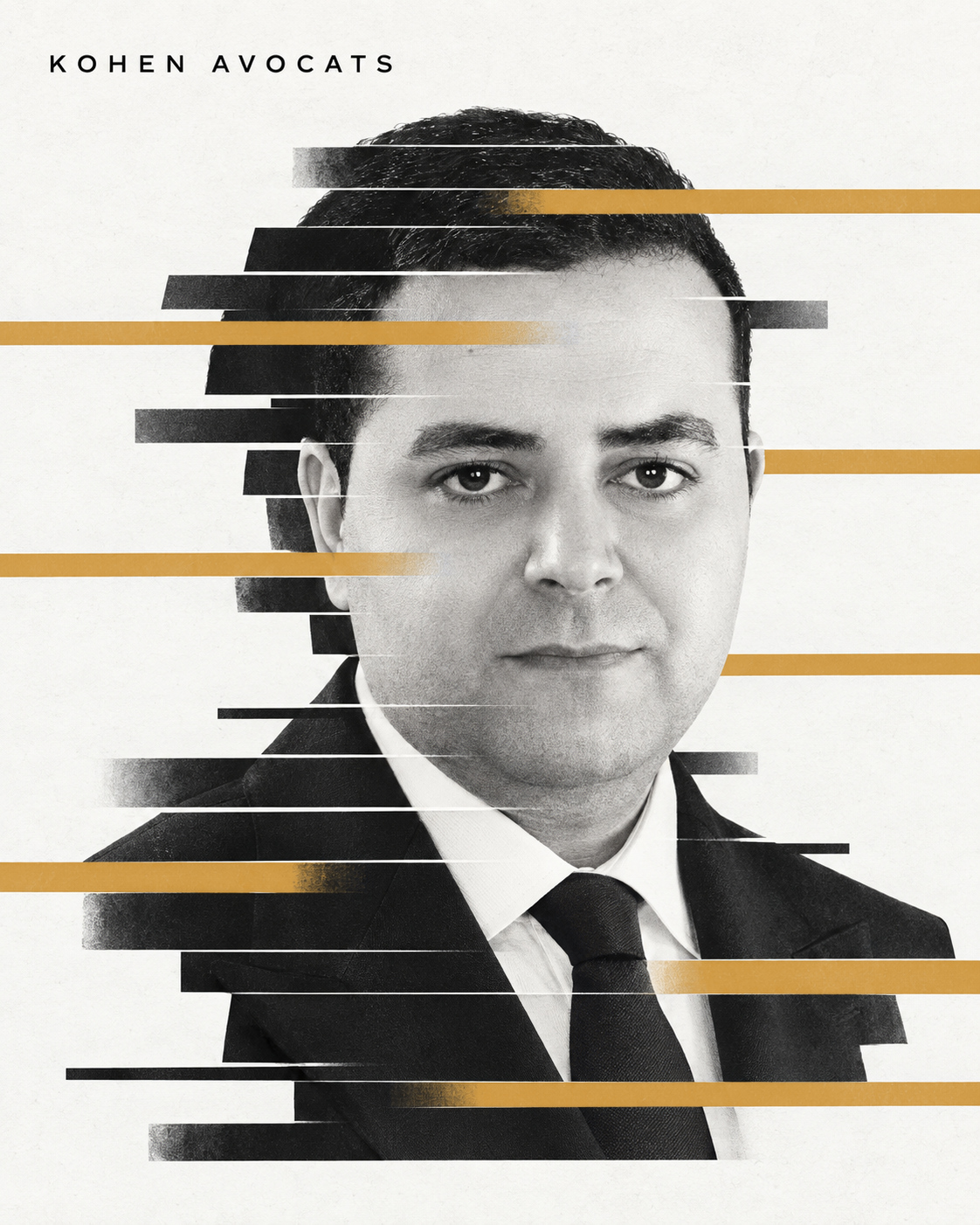
Reda Kohen, lawyer at the Paris Bar: industrial property, licence agreements and assignments of rights for innovative companies.
An inventive SME does not merely own a technical idea. It holds, or believes it holds, an exclusive right whose scope depends on the claims filed, on who actually owns the invention and on the deeds that followed the filing.
The firm can step in at every stage: preparing the filing alongside the patent attorney (conseil en propriété industrielle) responsible for the technical drafting, checking the rights of employee inventors, drafting and negotiating licences, assignments and contributions, and then maintaining the patent. Patent infringement litigation is covered here only insofar as it depends on those deeds.
Send what you have, even if incomplete: the firm will prioritise and complete the file with you. In an emergency, call +33 6 46 60 58 22.
Official profile in the directory of French lawyers (CNB)Firm at 11 rue Margueritte, 75017 Paris
A filing before any disclosure
Novelty is assessed at the filing date. A presentation at a trade fair, an article or an earlier commercial offer may be enough to destroy the application.
Deeds in writing and recorded
An assignment and a licence must be in writing on pain of nullity, and then recorded in the National Patent Register (Registre national des brevets) to be enforceable against third parties.
A patent to maintain
A patent lasts twenty years at most, provided the annual fees are paid. A missed payment results in forfeiture, and restoration is subject to short time limits.
The rules
Filing, licence, assignment: the applicable rules
Four rules govern the life of a patent in an SME.
- Inventions are patentable if they are new, involve an inventive step and are capable of industrial application (Article L. 611-10 of the French Intellectual Property Code). Novelty is lost through anything made available to the public before the filing date (Article L. 611-11). The Court of Cassation holds that “the novelty of an invention can be destroyed only by a prior art disclosure containing all of its features, which implies identity of elements, form, arrangement, operation and technical result” (Cass. com., 15 October 2025, No. 24-10.010, our translation).
- The right to the patent belongs to the inventor or their successor in title (Article L. 611-6). Where an employee has an inventive assignment, the invention belongs to the employer, which owes additional remuneration; other inventions connected with the business may be allocated to it for a fair price (Article L. 611-7).
- The rights attached to an application or a patent may be transferred and may be the subject of an exclusive or non-exclusive licence; these deeds must be in writing on pain of nullity under Article L. 613-8. They are enforceable against third parties only once recorded in the National Patent Register, except against those who knew of them when they acquired their own rights (Article L. 613-9).
- A patent is granted for twenty years from the filing date (Article L. 611-2) and gives rise to annual fees, with a six-month grace period (Article L. 612-19). If the fee is not paid, the holder forfeits its rights (Article L. 613-22).
A patent protects what the claims say, not the general idea of the project: the wording as filed determines the value of any later licence or assignment.
Your documents
What to send, depending on your position
The chronology of the invention and the deeds already signed determine which rights are actually available.
Position A
You file, license or assign
- Laboratory notebooks, drawings, dated prototypes and a list of the people who contributed
- Employment contracts, job descriptions and invention declarations of the employees concerned
- Confidentiality agreements, sales presentations and any document already circulated
- Patent application, search report, INPI opinion and proof of annual fee payments
Position B
You take a licence or buy
- Extract from the National Patent Register and status of the recorded entries
- Draft licence, assignment or contribution agreement, with its technical annexes
- Granted claims, oppositions, pending proceedings and known prior art
- Forecast figures used to set the royalties or the price
Do not present the invention at a trade fair, to an investor or to a customer before filing, except under a precise written confidentiality agreement.
The firm also handles:
- Industrial property
- Designs
- Unfair competition
- Legal due diligence
The method
How the firm supports you
Establish ownership, secure every deed and preserve the patent over time.
Step 1
Reconstructing the history of the invention
Conception dates, contributors, contracts in force and any disclosures: the firm checks who holds the right to the patent before any filing or negotiation.
Step 2
Preparing the filing with the patent attorney
The technical drafting of the claims is a matter for the patent attorney; the firm checks prior confidentiality, ownership and filing strategy.
Step 3
Drafting the licence or assignment
Scope, exclusivity, territory, royalties, guaranteed minimum, warranties, the fate of improvements and infringement actions: each clause is tied to the provision that governs it.
Step 4
Recording and maintaining the patent
Recording the deed in the National Patent Register, calendar of annual fees and follow-up of due dates: the firm checks the formalities on which enforceability against third parties depends.
A wrongly attributed patent or an unrecorded licence is often discovered during a fundraising or a buyer's audit, just when it weighs most heavily.
The timetable
The timeline of an SME patent
From the first technical idea to exploitation by a licensee or a buyer.
Conception
From the first tests. Date the work, identify the contributors and have a confidentiality agreement signed before any outside exchange.
Filing
File the application before any public presentation; the filing date fixes the prior art that can be set against the invention.
Search report
The INPI draws up a report on the prior art relevant to assessing novelty and inventive step.
Grant and opposition
After grant, a third party may file an opposition with the INPI under the conditions set by decree.
Licence or assignment
Sign a written deed, then record it in the National Patent Register to make it enforceable against third parties.
Maintenance
Pay each annual fee when due; the six-month grace period carries a surcharge.
The checks
What the firm checks before you sign
No deed concerning a patent should rest on assumed ownership.
- Ownership: identified inventors, employment contracts, inventive assignments and any allocations in favour of the company.
- Novelty: no disclosure before filing, confidentiality agreements and dates of outside presentations.
- Status of the patent: granted claims, oppositions, annual fees paid and entries in the National Patent Register.
- Contract: signed writing, scope of the rights, exclusivity, royalties, guaranteed minimum, warranties and the fate of improvements.
- Co-ownership: shares, co-ownership regulations, the agreement of all co-owners for an exclusive licence and the right of pre-emption where a share is assigned.
Summary
Situation, evidence, response
The situations an inventive SME most often faces set the first priority of the file.
Situation
Presentation planned before filing
Decisive evidence: Date of the trade fair or meeting, material presented, confidentiality agreement.
Time limit: The filing must precede any public disclosure.
Useful action: Bring the filing forward or limit the presentation to a circle bound by confidentiality.
Situation
Invention made by an employee
Decisive evidence: Employment contract, job description, invention declaration, work assigned.
Time limit: Two months to respond to the declared classification, four months to claim attribution, running from the complete declaration (Articles R. 611-6 and R. 611-7).
Useful action: Classify the invention, arrange the attribution and provide for the remuneration owed.
Situation
Exclusive licence to an industrial partner
Decisive evidence: Draft contract, claims, sales forecasts.
Time limit: Before recording, the deed is enforceable only against third parties who knew of it.
Useful action: Set the royalties, guaranteed minimum, sales audit and infringement action.
Situation
Assignment or contribution to a company
Decisive evidence: Written deed, identification of the parties, register extract.
Time limit: Record the deed as soon as it is signed.
Useful action: Provide for rights over prior acts and for the assignor's warranties.
Situation
Unpaid annual fee
Decisive evidence: Due-date notice, notification of forfeiture, exchanges with the representative.
Time limit: Six-month grace period, then a restoration request subject to strict conditions.
Useful action: Pay or file the request within the time limits of Article L. 612-16.
Situation
Patent shared with a partner
Decisive evidence: Collaboration agreement, shares, co-ownership regulations.
Time limit: Notify any planned licence or assignment to the other co-owners.
Useful action: Negotiate co-ownership regulations suited to the intended exploitation.
Frequently asked questions
Your questions: patents
Can an SME show its invention before filing the patent?
In principle, no. Article L. 611-11 of the Intellectual Property Code defines the state of the art as everything made available to the public before the filing date, by written or oral description, use or any other means. A demonstration at a trade fair, an online video, a sales brochure or an offer sent to a customer without any confidentiality obligation can therefore be set against the application.
Article L. 611-13 disregards a disclosure made in the six months before filing in only two narrow cases: an evident abuse against the inventor, or a presentation at an official or officially recognised exhibition within the meaning of the 1928 convention, declared at the time of filing. An ordinary trade fair does not, on its own, fall within that scope.
However, a prior art disclosure destroys novelty only if it reproduces the invention in all its elements. The Court of Cassation reiterated this in approving a court of appeal that had distinguished a suction hose from an electric cable subject to different constraints (Cass. com., 15 October 2025, No. 24-10.010). The firm lists the communications already made and checks their exact content before fixing the filing date.
How can the invention be protected during discussions with an industrial partner?
By a confidentiality agreement signed before the first technical meeting. It should identify the protected information, the purpose for which it may be used, the people authorised to know it and the duration of the undertaking. A dated annex listing the documents handed over makes proof easier in the event of a dispute.
Publication of the patent application does not release the partner from all its obligations. The Court of Cassation holds that “publication of a patent application discloses to the public only the technical characteristics and the information relating to the invention that it contains” (Cass. com., 17 May 2023, No. 19-25.007, our translation). It set aside the judgment that treated the agreement as lapsed upon publication, even though other exchanges remained covered.
The agreement is not enough to establish authorship of the invention. In a dispute in which a collaborator claimed that a company had filed his process, the Paris Court of Appeal noted that “the invention is protected only by what is set out in the claims” and dismissed the action, for lack of proof that the patented invention had been taken from him (CA Paris, pôle 5 ch. 2, 17 February 2023, No. 21/08764, our translation). The composition handed over in confidence was based on sodium citrate, whereas the patent concerned citric acid, and the court held that the two compounds are not interchangeable. The SME should therefore keep dated evidence that corresponds precisely to what it files.
Can software, an interface or a business method be patented?
Not as such. Paragraph 2 of Article L. 611-10 of the Intellectual Property Code excludes in particular mathematical methods, methods in the field of economic activities, computer programs and presentations of information, where the application relates to those items considered as such.
A recent decision illustrates the limit, to the applicant's detriment. The Court of Cassation dismissed the appeal against the rejection of an application concerning the display of the stages of a flight on a timeline (Cass. com., 7 October 2026, No. 25-15.279). It accepts the patentability of such a claim only “unless it refers to a technical device or means that produces a technical effect making a technical contribution to the problem set out in the patent application” (same judgment, our translation). The effect relied on must not depend on the user's subjective preferences.
For an SME developing embedded software, a control process or a sensor, the issue is therefore to identify the technical effect produced and to make it appear in the claims. Where the application shows no technical contribution, the patent route is closed and other forms of protection, subject to their own conditions, must be examined. The firm can study these options with the patent attorney in charge of the filing.
How does the court assess inventive step?
Under Article L. 611-14 of the Intellectual Property Code, an invention involves an inventive step if, to a person skilled in the art, it does not follow in an obvious manner from the state of the art. The choice of that person skilled in the art is often decisive.
The Court of Cassation states that “the person skilled in the art is the one in the technical field in which the problem arises that the invention, the subject of the patent, sets out to solve” (Cass. com., 19 March 2025, No. 23-13.576, our translation). It set aside, in favour of the patentee, a judgment that had taken a general electronics engineer as the person skilled in the art, although the invention concerned the electrical power supply of aircraft cabins.
It also frames reasoning by combining prior documents: “elements of the prior art destroy inventive step only if, combined with one another in a way reasonably accessible to the person skilled in the art, they would obviously have enabled that person to bring to the problem solved by the invention the same solution as the invention” (Cass. com., 24 June 2026, No. 24-14.680, our translation). For an SME, these criteria matter from the moment of filing: the description must set out clearly the technical problem and the advantage obtained, because these are what will be argued in the event of an opposition or an invalidity action based on Article L. 613-25.
Does an employee's invention belong to the SME that employs them?
It depends on its category. Article L. 611-7 of the Intellectual Property Code allocates to the employer inventions made in the performance of a contract that includes an inventive assignment corresponding to the employee's actual duties, or of studies expressly entrusted to the employee. The employee then receives additional remuneration set by the collective agreement, the company agreement or the contract. Other inventions belong to the employee, but the employer may have allocated to it those connected with the employee's duties or with the company's activities or resources, for a fair price.
The Court of Cassation accepts that the employer may assign its right in an invention made in the course of the employee's assignment: “the right to the patent on that invention belongs solely to the employer. No provision prevents the employer from assigning that right to a third party” (Cass. com., 5 January 2022, No. 19-22.030, our translation). In that case, the employee-inventor's claim for ownership against the assignee was dismissed.
A dispute over additional remuneration is not for the employment tribunal (conseil de prud'hommes). The Social Chamber approved the finding that the employment tribunal lacked jurisdiction, the action falling within the exclusive jurisdiction of the judicial court (tribunal judiciaire) (Cass. soc., 23 October 2024, No. 22-19.700). The SME should therefore put the invention declaration, the classification and the remuneration in writing as soon as technical staff are hired.
What form must the assignment of a patent take?
A writing, on pain of nullity. Article L. 613-8 of the Intellectual Property Code covers any transfer of the rights attached to an application or a patent, in whole or in part, as well as licences. A verbal agreement or an ambiguous exchange of emails leaves the transfer open to challenge: the writing must establish unequivocally the parties' agreement and the rights transferred.
In an infringement dispute, the Paris Court of Appeal examined a deed of assignment challenged by the defendant, who complained of the absence of the parties' addresses and registration numbers. It held that “the deed of assignment is indeed evidenced in writing as required by the last paragraph of Article L. 613-8 of the Intellectual Property Code” and declared the assignee entitled to bring proceedings for acts predating the assignment (CA Paris, pôle 5 ch. 1, 1 October 2025, No. 24/12410, our translation). The outcome also depended on the foreign law governing the contract, which rules out drawing a general rule from it.
For an SME, a useful deed of assignment specifies at a minimum the full identification of the parties, the application or patent numbers, the countries covered, the price and how it is paid, the assignor's warranties, the fate of earlier infringing acts and the obligation to record. The same care is needed for the contribution of a patent to a company's capital.
Why record the assignment or licence in the National Patent Register?
Because a deed that has not been recorded is not enforceable against third parties. Article L. 613-9 of the Intellectual Property Code requires the recording of all deeds transferring or modifying the rights attached to a patent, except as against a third party who knew of the deed when it acquired its own rights.
The consequence is concrete for the buyer. The Court of Cassation holds that “until the transfer has been recorded in the register, the successor in title cannot rely on the rights arising from the deed that transferred ownership of the patent to it” (Cass. com., 24 April 2024, No. 22-22.999, our translation). The buyer therefore cannot bring an infringement action before recording.
Once the recording is made, the regularisation takes effect. The same decision allows compensation for acts committed since the transfer and, “if the deed transferring the rights so specifies, for the harm caused to it by acts committed before the transfer” (Cass. com., 24 April 2024, our translation). The clause in the deed on earlier acts therefore has direct effect.
The same article nonetheless allows a licensee whose contract is not recorded to intervene in the infringement proceedings brought by the holder, in order to obtain compensation for its own harm. The firm checks the register extract before any purchase and arranges the recording as soon as the deed is signed.
Exclusive or non-exclusive licence: what difference does the choice make for the SME?
Article L. 613-8 of the Intellectual Property Code allows an exclusive or non-exclusive licence to be granted, in whole or in part. The holder may enforce the patent against a licensee who exceeds the limits of the licence, for example by exploiting outside the territory, field of application or duration provided for.
The choice changes how the patent is defended. Under Article L. 615-2, the exclusive licensee may bring an infringement action, unless the contract provides otherwise, provided it informs the holder beforehand; the non-exclusive licensee may do so only if the contract expressly authorises it, and it too must inform the holder beforehand, on pain of inadmissibility. The validity of the patent cannot be challenged in the licensee's action if the holder is not a party to the proceedings.
Exclusivity calls for something in return: an obligation to exploit, minimum royalties, sales targets, a right to take back exclusivity in the event of non-performance. Where the patent belongs to several co-owners, an exclusive licence requires the agreement of all of them or court authorisation (Article L. 613-29). The firm drafts the territory clause, the fate of improvements and the allocation of infringement actions according to the SME's business model, whether it is licensor or licensee.
How can the royalties under a patent licence be secured?
The contract must set the basis, the rate, the frequency, the proof of sales and the penalties for late payment. Recent case law shows that these clauses are applied as written, which means they must be drafted precisely.
In an exclusive licence providing for a percentage of sales and a monthly minimum, the Paris Court of Appeal held that the minimum remained due even without sales, the parties having agreed a guaranteed minimum “applying, even in the event of non-exploitation, for the contractual term of three years” (CA Paris, pôle 5 ch. 1, 5 March 2025, No. 22/10410, our translation). It refused to treat this as a penalty clause, the stipulation being intended “not to penalise the breach of an undertaking but to compensate on a lump-sum basis a shortfall in royalties” (same judgment, our translation). The licensee was ordered to pay.
For its part, the Riom Court of Appeal noted that the licensee had undertaken to keep separate accounts for the exploitation and held that it could not make payment of the royalties conditional on the patentee issuing invoices (CA Riom, ch. com., 5 November 2025, No. 24/01527). These decisions rule on particular contracts: the rates and amounts they mention are not a benchmark. The firm provides for an audit right, periodic statements and a suitable termination clause.
What happens if the SME forgets to pay an annual fee?
Annual fees must be paid when due, with a six-month grace period on payment of a surcharge (Article L. 612-19 of the Intellectual Property Code). After that period, the holder forfeits its rights as of the unpaid due date (Article L. 613-22).
An application for restoration exists, but it is bound by strict time limits. Article L. 612-16 requires a legitimate excuse and an application made within two months of the end of the impediment, the period within which the omitted act must also be performed. The application is admissible only within the year following the expiry of the time limit not observed, which, for an annual fee, means the six-month grace period; restoration also requires payment of the fees due within the regulatory time limit.
The Court of Cassation applies these time limits strictly, to the patentee's detriment. It holds that “the notification of the decision recording the forfeiture of a patent, whether made to the patentee or to its representative, puts an end to the legitimate excuse” (Cass. com., 17 May 2023, No. 22-10.744, our translation). An application made more than two months after that notification was declared inadmissible, and the representative's default was not accepted as an excuse for the holder.
An SME should therefore keep a calendar of annual fees for each country, appoint an internal person responsible and check the notices sent by its representative. In an assignment or a licence, the contract states who pays the annual fees.
How can a patent co-owned with a partner be exploited?
A joint filing with a laboratory, a customer or a partner creates a co-ownership governed by Article L. 613-29 of the Intellectual Property Code. Each co-owner may exploit the invention for its own benefit, subject to fairly compensating those who do not personally exploit the invention or have not granted a licence. Each may bring an infringement action for its own benefit, provided the writ of summons is notified to the others.
Licences are subject to a more demanding regime. A non-exclusive licence requires the plan to be notified to the other co-owners together with an offer to sell the share at a stated price; they have three months to object by buying that share. An exclusive licence requires the agreement of all or court authorisation. The assignment of a share gives rise to a three-month right of pre-emption.
These rules apply only in the absence of contrary provisions, and the co-owners may depart from them at any time by means of co-ownership regulations (Article L. 613-32). For an SME, these regulations are often the most useful deed of a research partnership: they set out who files, who pays the annual fees, who exploits in which field, how royalties are shared and what happens if a partner leaves.
A third party has filed the SME's invention: what can be done?
Article L. 611-8 of the Intellectual Property Code provides an action for ownership where the patent was applied for in respect of an invention taken from the inventor or in breach of a legal or contractual obligation. It is subject to a five-year limitation period running from publication of the grant, or from expiry of the patent where there was bad faith when the patent was granted or acquired.
Until that action succeeds, the applicant retains certain prerogatives. The Court of Cassation holds that the applicant, even if it knew it was not entitled to the patent, has “until any action for ownership brought against it succeeds, standing and an interest to bring an infringement action against any third party” (Cass. com., 24 June 2026, No. 24-14.680, our translation). The ownership action should therefore be brought without delay.
The burden of proof remains on the claimant. In the case decided by the Paris Court of Appeal on 17 February 2023, the action was dismissed because the documents produced did not correspond to the invention as claimed (CA Paris, pôle 5 ch. 2, 17 February 2023, No. 21/08764). The firm gathers the dated documents, signed agreements and exchanges that establish the origin of the invention, then compares them with the published claims before acting.
A competitor exploits the patented invention: what remedies does the SME have?
Without the holder's consent, the manufacture, offer, placing on the market, use, import, export or possession for those purposes of the patented product are prohibited (Article L. 613-3 of the Intellectual Property Code). Any breach of those rights constitutes infringement giving rise to the civil liability of its author (Article L. 615-1). The same provision, however, holds a person other than the manufacturer liable, for offering, placing on the market, using or possessing the product, only if that person acted knowingly.
Evidence is prepared before the writ of summons is served. Article L. 615-5 allows a detailed description or a seizure of the products or processes alleged to infringe to be carried out on an order issued on application. To set damages, the court takes into account separately the negative economic consequences, including lost profits and losses suffered, the non-material damage and the infringer's profits, including its savings on investment. At the injured party's request, it may instead award a lump sum higher than the royalties that would have been due, without excluding compensation for non-material damage (Article L. 615-7).
The action is subject to a five-year limitation period running from the day the holder knew or should have known the last fact enabling it to bring the action (Article L. 615-8). It falls within the jurisdiction of the Paris judicial court (tribunal judiciaire), in the cases and on the conditions laid down by the Code (Article L. 615-17 and Article D. 211-6 of the Code of Judicial Organisation). Before acting, the SME checks that the patent is recorded in its name, that the annual fees are paid and that the rights of action granted to licensees by contract are identified: these are the first points the defence will raise.
Sources and related pages
Official texts and related pages
The sources for this page and the firm's related areas of practice.
Further reading
Page updated on 1 November 2026.
An invention to file, license or assign? Take stock today.
Send the application or patent, the contracts already signed and the draft deed: the firm checks ownership, the formalities to complete and the clauses to negotiate.
The latest news.
What our clients say
Best real estate law and business law lawyer in Paris. A humane and attentive lawyer, with a wonderful team. Thank you, Maître KOHEN
Translated from French
Thank you to Maître KOHEN for his analyses of recent case law on fraudulent non-disclosure in property sales. It reassures me about an action for annulment that I am considering after buying a house affected by serious defects intentionally concealed by the seller and not reported by the estate agent; also defects (rising damp) characterised by spreading through-cracks and damp stains, not reported by the estate agent… Worse, defects concealed by the latter or at his instigation, under a coat of paint and by polystyrene tiles glued to the ceiling of a bedroom. And the said estate agent drafted the preliminary contract, which of course contains no information about any of these defects. Just to add that, being 77 years old and suffering from cognitive impairment, I am certain that the estate agent thought I would not be able to discover the deception and above all to establish the fraudulent intent, still less to bring legal proceedings given the complexity and length of the procedure... That is why I am opting for the criminal route, insofar as the intentional concealment of the defects by the seller and then by the estate agent amounts to the fraudulent manoeuvres of art. 313-1 of
Translated from French
Maître Reda KOHEN assisted me in a dispute concerning a sale agreement with a defaulting party. He provided professional and responsive support, and I highly recommend him.
Translated from French
I highly recommend Maître Reda Kohen. Thanks to his explanations, I was able to recover my security deposit in a situation that seemed blocked. He was responsive, clear, and very professional. A big thank you for his invaluable help!
Translated from French
Excellent support from Maître Kohen in a case combining business law and real estate law. Clear legal analysis from the first meeting, right through to the hearing. Professional and accessible lawyer, I highly recommend his firm in Paris 17.
Translated from French
Maître Kohen assisted me in recovering unpaid debts from a defaulting tenant. Procedure mastered from start to finish, from the payment order to eviction. Human, attentive, and always reachable. Thank you for your work.
Translated from French
As a young student living in an apartment, my landlord tried to make me leave my accommodation even though he had sent me no termination notice. I therefore contacted Mr. Reda Kohen to help me as I couldn’t handle the situation alone. In just 3 days everything was resolved, Maître Kohen defended me and accompanied me with an irreproachable level of commitment and efficiency. I can only recommend his professionalism!
Translated from French
I turned to Maître Kohen for a complex real estate dispute and I highly recommend his firm. He is very professional; he thoroughly analyzed my case from the very first appointment and clearly explained the possible options. Thanks to his expertise, we achieved a very favorable outcome. Responsive, a good teacher, and committed, he is a lawyer you can truly trust. Yours faithfully, Miss Maazaz
Translated from French
Very satisfied! I would like to thank Maître Esther Cornu here, who managed to resolve a very complicated dispute in a divorce and family law matter...Thanks to Maître Cornu, a judgment was handed down in my favour even though it was far from a foregone conclusion...So I recommend this law firm
Translated from French
A precise and concrete analysis and an immediate response. Excellent.
Translated from French
I highly recommend this lawyer for his professionalism, honesty, and transparency. He helped me successfully and guided me through the process with great care and expertise. What I particularly appreciated was his honest approach and the fact that he recommended practical, cost-effective options instead of immediately pushing for the most expensive solution. He genuinely focused on finding the right approach for my situation. I’m very grateful for his support and would definitely recommend him to anyone looking for a trustworthy and professional lawyer in France.
Thank you for this detailed, precise help, with a proposal at the end on whether or not to continue (very quick response as well)
Translated from French
Very good advice given by Maître Cornu during our meeting on 16 October.
Translated from French
Very professional and responsive service. The lawyer quickly and carefully checked the validity of my wife’s residence permit in light of a specific legal regime. His work gave us clarity, whereas the usual administrative procedures were long and ambiguous. I appreciated his efficiency and professionalism, and I recommend his services.
Translated from French
I would like to warmly thank Maître Esther Cornu for her professionalism, her availability and the quality of her support. In a case of particular importance for my professional future, she showed great responsiveness, rigour and a gift for explaining things, taking the time to answer my questions precisely and to explain the various legal steps to me. I particularly appreciate the clarity of her analyses, her seriousness and her commitment in following up my case. Many thanks to Maître Esther Cornu for listening and for her support. I highly recommend!
Translated from French
I was pleasantly surprised by the responsiveness of Mr Reda Cohen, who took the time to answer my questions about my case instantly. It has become so rare these days to find a lawyer who is so available, responsive and attentive, even when it is simply a matter of answering questions. His answers are clear, precise and reassuring. You can tell that he takes the time to understand the situation and to provide relevant answers. Beyond his excellent ratings on Google, it is above all this availability and this seriousness that make the difference. Many thanks to Mr Reda Cohen for his professionalism and his responsiveness. I highly recommend!
Translated from French
A huge thank you to Maître Esther Cornu from Kohen Avocats for her support during a particularly difficult time. Her attentiveness, empathy, and humanity touched me deeply. She was able to answer my questions with clarity and sensitivity, while demonstrating great professionalism and fully respecting the confidentiality of the case. Beyond her professional qualities, I met a deeply humane lawyer whose support made a real difference. I sincerely recommend her.
Translated from French
Good experience. And good work, thank you for everything.
Translated from French
Saw Hassan on the TV news
Translated from French
very clear article
Translated from French
Loading…
Your cookies
We use cookies to measure the effectiveness of our campaigns and improve the site. You can change your choice at any time.