Dissolution and voluntary liquidation — directors and shareholders
Company dissolution lawyer in Paris: close without hidden liabilities.
The voluntary route presupposes a company that can pay its debts: otherwise, insolvency proceedings are required. As a company dissolution lawyer in Paris, the firm secures the decision, the settlement of liabilities, the closure and the deregistration — and defends you when the closure was badly handled.
Pursuing a voluntary dissolution when the available assets no longer cover the liabilities that have fallen due exposes the director to liability for shortfall in assets: cash is measured before the route is chosen.
Company dissolution and liquidation · Paris
Get a first analysis
Activity stopped, deadlocked shareholders or a TUP under consideration: send the articles of association, the latest accounts and the cash position statement. The firm replies within 24 business hours with the appropriate route.
24 à 48 h
first legal
review

Kohen Avocats, Paris 17
Dissolution: what really decides the closure
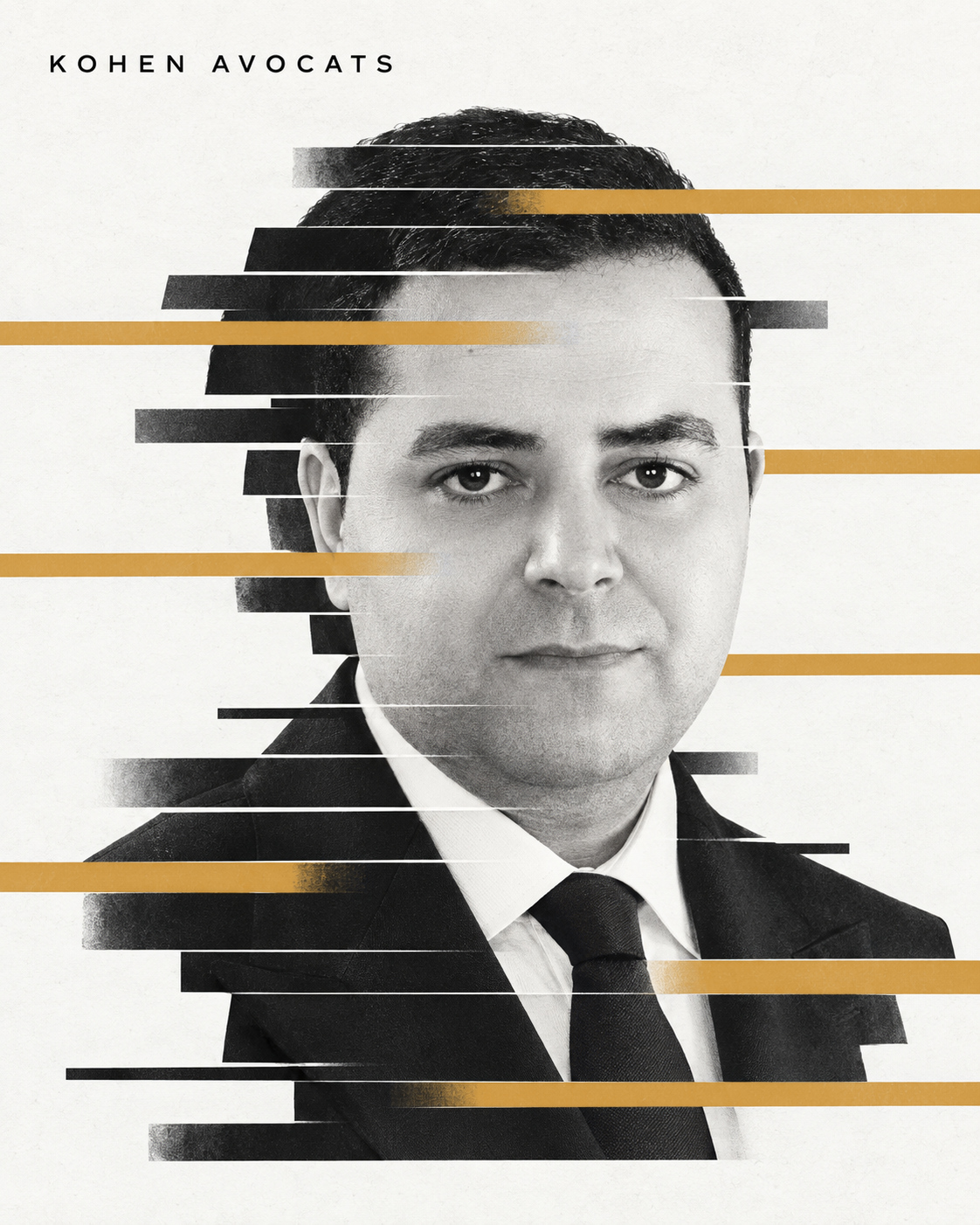
Company law · Paris 17th arrondissement
What a company dissolution and liquidation lawyer in Paris does
- Paris Bar
- Company law
- Firm in Paris 17th arrondissement
Lawyer at the Paris Bar — company dissolutions, liquidations and closures.
A voluntary dissolution is decided at an extraordinary general meeting (AGE), is published, and opens the liquidation: realisation of assets, payment of debts, final accounts, closing meeting, discharge (quitus), distribution of the liquidation surplus under Article 1844-9 of the French Civil Code (Code civil), and deregistration. The universal transfer of assets and liabilities (TUP) to a sole shareholder that is a legal entity avoids liquidation, with creditors able to object for thirty days (Article 1844-5). The liquidation must be closed within three years. If cessation of payments is established, the voluntary route is closed.
Send what you have, even if incomplete: the firm will prioritise and complete the file with you. In an emergency, call +33 6 46 60 58 22.
Official profile in the directory of French lawyers (CNB)Firm at 11 rue Margueritte, 75017 Paris
Precise legal grounds
Expiry of the term, completion or extinction of the corporate purpose, decision of the shareholders, judicial dissolution for just cause — including a deadlock that paralyses the company's operation (Article 1844-7 of the Civil Code).
A supervised liquidator
Recover, sell, pay, report: extensive but limited powers, the mention “company in liquidation”, and liability that remains engaged for three years (Article L. 237-12 of the French Commercial Code, the Code de commerce).
A legal personality that survives
The legal personality subsists until the closure is published: the company acts in court through its liquidator — a little-known point that saves or loses proceedings.
The route
Voluntary, judicial or collective: do not confuse them
Four rules structure the closure of a company.
- The voluntary route requires solvency: if the available assets no longer cover the liabilities that have fallen due, insolvency proceedings are required and continuing the voluntary route engages the director's liability.
- Judicial dissolution for just cause penalises in particular a deadlock that paralyses the company's operation (Article 1844-7, 5° of the Civil Code; decision linked on the page) — the disappearance of affectio societatis is not enough without actual paralysis.
- The TUP under Article 1844-5, paragraph 3, transfers the assets and liabilities to the sole shareholder that is a legal entity without liquidation, with creditors able to object for thirty days.
- The liquidator is liable for their faults for three years (Article L. 237-12 of the Commercial Code and Article 1240 of the Civil Code; decision linked on the page): closing without a provision for pending litigation exposes them.
Deregistration closes the legal entity, but the legal personality subsists until the closure is published: the company can sue and be sued through its liquidator during the liquidation. The sequence must be respected: published minutes, INPI, the mention “company in liquidation”, traced transactions, closing meeting, discharge, deregistration.
Your documents
What you need to gather to close
Traceability of the settlement of liabilities protects the liquidator and the shareholders.
Position A
Before the decision
- Articles of association and latest annual accounts
- Cash position and liabilities that have fallen due
- Pending disputes and necessary provisions
- Contracts to terminate: lease, subscriptions, staff
Position B
During the liquidation
- Dissolution minutes and publication
- Asset transfer agreements, receipts
- Tax and social security evidence of the settlement of liabilities
- Final accounts and closing minutes
Common mistakes: closing without a provision for a pending employment tribunal dispute; confusing voluntary dissolution with insolvency proceedings when cash no longer keeps pace.
The firm also handles:
- TUP of the sole shareholder
- Judicial dissolution for deadlock
- Liquidation surplus and shortfall
- Defence of the liquidator
The method
How the firm supports you
Reversing a step blocks deregistration from the trade register.
Step 1
Solvency diagnosis
Available cash against liabilities that have fallen due: choosing the voluntary route or steering towards insolvency proceedings.
Step 2
Decision and publication
Extraordinary general meeting resolving the dissolution, appointment of the liquidator, publication in a legal notices newspaper, INPI formality.
Step 3
Traced liquidation
Realisation of assets, orderly payment of debts, provisions for disputes, final accounts.
Step 4
Closure and deregistration
Closing meeting, discharge, distribution of the surplus or bearing of the shortfall, publication and deregistration.
Benchmarks: liquidation to be closed within three years; thirty-day creditor objection period in a TUP; typical duration of six to eighteen months depending on the liabilities.
The timetable
The timeline of a voluntary dissolution
From the decision to deregistration.
Decision
Week 1. Extraordinary general meeting resolving the dissolution, minutes, liquidator appointed, powers set.
Publication
Within the month. Legal notice of the dissolution and of the appointment, INPI filing with the mention “company in liquidation”.
Operations
Months 1-12. Collection of receivables, sale of assets, payment of debts, provisions for disputes.
Accounts
End of liquidation. Final accounts, notice of the closing meeting.
Closure
Approval of the accounts, discharge of the liquidator, distribution of the surplus or shortfall (Article 1844-9).
Deregistration
Publication of the closure, deregistration from the RCS: the legal personality ceases to exist.
The checks
What the firm checks before the decision
No dissolution without these points being validated.
- Solvency: available assets against liabilities that have fallen due, at the time the route is chosen.
- Pending disputes and corresponding provisions before any closure.
- Latent tax and social security debts settled and evidenced.
- Regularity of the meetings: dissolution then closure, majorities required by the articles of association.
- Liquidation surplus: tax consequences planned in advance, proportional distribution.
- Liquidator's liability: limited mandate, full traceability.
Summary
Situation, risk, document, decision
The most frequent trade-offs seen at the firm in dissolution cases.
Situation
Activity stopped for several months, positive cash
Main risk: Blocked account, latent tax debts.
Document to prepare: Minutes of voluntary dissolution.
Recommended decision: Start the dissolution without waiting for cessation of payments.
Situation
Deadlock between shareholders paralysing the company's operation
Main risk: Refusal to vote for the voluntary dissolution.
Document to prepare: Writ of summons for judicial dissolution (1844-7 5°).
Recommended decision: Apply to the court on proof of actual paralysis.
Situation
Company with a sole shareholder that is a legal entity
Main risk: Automatic TUP, creditor objection within 30 days.
Document to prepare: Minutes of dissolution without liquidation, publication in a legal notices newspaper.
Recommended decision: List the creditors, plan the guarantees to be offered.
Situation
Employment tribunal or commercial proceedings pending
Main risk: Premature closure, liability claim against the liquidator.
Document to prepare: Provision in the liquidation accounts.
Recommended decision: Defer the closure until the dispute is resolved.
Situation
Unsold stock, equipment with no realisable value
Main risk: Liquidation shortfall to be borne by the shareholders.
Document to prepare: Itemised inventory, takeover quotes.
Recommended decision: Document each sale or write-off with supporting evidence.
Situation
Unrepaid shareholder current account
Main risk: Outright loss for the lending shareholder.
Document to prepare: Written decision to waive or partially repay.
Recommended decision: Settle the fate of the current account before the distribution.
Frequently asked questions
Your questions: company dissolution and liquidation
What is the difference between voluntary dissolution, judicial dissolution and insolvency proceedings?
Three very different routes. Voluntary dissolution is decided by the shareholders when the company can pay its debts. Judicial dissolution is ordered by the court for just cause, in particular where a deadlock paralyses the company's operation (Article 1844-7, 5° of the Civil Code). Insolvency proceedings (safeguard, reorganisation, judicial liquidation) apply when the company can no longer meet its liabilities that have fallen due with its available assets. Pursuing a voluntary dissolution when there is cessation of payments is a fault on the part of the director.
When does a deadlock between shareholders justify judicial dissolution?
Only if it genuinely paralyses the company's operation. The Court of Cassation regularly quashes judgments that order dissolution without establishing actual paralysis (Cass. com., 5 April 2018, No. 16-19.829). Conversely, dissolution is upheld where the conflict prevents any decision from being taken as required by the articles of association and the affectio societatis has disappeared (Cass. 1re civ., 16 October 2013, No. 12-26.729). The case must demonstrate the facts, the failures to act and the harm to the company.
Who can be appointed as voluntary liquidator?
A shareholder, the current director, a third party or a professional (lawyer, chartered accountant). The articles of association may lay down requirements for the liquidator. Failing that, the shareholders appoint freely by the majority required to amend the articles. In the event of deadlock, the court makes the appointment on the application of any interested person. The liquidator must be independent, available and able to bear the civil liability attached to the role.
How long does a voluntary dissolution take?
Between six and eighteen months in practice. The operational phase begins with the dissolution minutes and ends with deregistration from the RCS. The duration depends on the complexity of the liabilities, the number of creditors, how quickly the assets are sold and any pending disputes. Article 1844-8 of the Civil Code requires closure within a maximum of three years; failing that, the court can be asked to have the liquidation completed.
How is the liquidation surplus taxed?
The surplus is the difference between the positive balance after settlement of liabilities and the capital repaid. For individual shareholders, it is taxed as distributed income: the 30% flat tax by default, or the option for the progressive scale with a 40% allowance. For corporate shareholders, the surplus is subject to corporate income tax, with the parent-subsidiary regime possible if the shareholding exceeds 5%. The calculation should be planned for from the decision to dissolve.
What should be done if the liquidation ends in a shortfall?
A shortfall arises when liabilities exceed assets. Shareholders' current accounts are absorbed first. If that is not enough, the shareholders contribute to the losses according to the articles of association and the corporate form (limited to contributions in an SAS and an SARL, unlimited in an SCI and an SNC). If the shortfall reveals a cessation of payments, the voluntary liquidator must defer closure and apply for insolvency proceedings to be opened, failing which they risk personal liability.
How are creditors protected in a dissolution?
Through several safeguards. The company keeps its legal personality until the closure is published (Article 1844-8). The liquidator must settle the liabilities in full before any distribution. Creditors can object to the dissolution within thirty days in the case of a universal transfer of assets and liabilities to a sole shareholder that is a legal entity (Article 1844-5, paragraph 3). Closing without a provision for pending litigation engages the liquidator's civil liability (Cass. 3e civ., 11 December 2025, No. 21-14.676).
What is the universal transfer of assets and liabilities (TUP)?
A TUP takes place when all the shares of a company are held by a single shareholder that is a legal entity and that shareholder decides to dissolve it. The whole of the dissolved company's assets and liabilities is transferred automatically to the shareholder, without liquidation proceedings. Creditors have thirty days from publication to object. A TUP does not apply where the sole shareholder is an individual: a standard liquidation is then required.
Can the director be held liable after deregistration?
Yes, in several situations. A management fault committed before the dissolution can give rise to a liability action under ordinary law. If the deregistered company turns out to have been in cessation of payments, an action for liability for shortfall in assets (Article L. 651-2 of the Commercial Code) remains possible if insolvency proceedings have been opened. Personal commitments (suretyship, first-demand guarantee) survive deregistration. A well-conducted voluntary dissolution drastically limits these risks.
What should be done about an employment tribunal dispute during the liquidation?
The liquidator must provision the amount likely to be owed before any distribution to the shareholders. A premature closure without a provision engages the liquidator's liability under Article L. 237-12 of the Commercial Code. The Court of Cassation has specified that the creditor's harm is analysed as a loss of a chance, measured by the percentage of chances lost (Cass. 3e civ., 11 December 2025, No. 21-14.676). Ideally, one waits for the outcome of the dispute before closing.
How much does a voluntary dissolution cost in Paris?
Beyond the statutory costs (around €200 to €300 for publication in a legal notices newspaper and the INPI filing), the fees for assistance vary with the complexity of the liabilities. A simple dissolution without litigation generally starts from €2,500 incl. VAT. A liquidation involving the settlement of pending disputes, negotiation with creditors and tax coordination exceeds €5,000 incl. VAT. The firm proposes a fixed fee after an initial audit of the accounts and of the situation.
Must the dissolution be published in a legal notices newspaper?
Yes, it is mandatory. Publication takes place within the month following the dissolution minutes, in an authorised medium in the département of the registered office. It informs third parties of the dissolution, the appointment of the liquidator and the new registered office (where applicable). A second publication is required at closure, so that the deregistration can be relied on against third parties. The date of publication starts the thirty-day objection period in the case of a TUP.
What is the discharge given to the liquidator?
The discharge, known as the quitus, is the vote by which the closing meeting approves the liquidator's final accounts and releases the liquidator from liability for their management (Article L. 237-9 of the Commercial Code). It amounts to a waiver of any liability action against the liquidator for the facts brought to the shareholders' attention. It does not exclude liability for concealed facts, nor actions by third parties (creditors, the tax authority) who did not vote.
Can an SCI be dissolved by agreement?
Yes, like any civil company. The majority required for the dissolution decision is in principle unanimity, unless the articles of association provide otherwise. The liquidator realises the assets, pays the debts and divides the net assets among the partners in proportion to their rights. What is specific to an SCI is the preferential allocation of a property to a partner in proportion to their share, possible by a partition agreement. The tax treatment of the surplus depends on whether the SCI is subject to income tax or corporate income tax.
Which court has jurisdiction over a dispute about the dissolution of a Paris company?
Disputes relating to the dissolution, or to the appointment or liability of the liquidator, fall within the jurisdiction of the commercial court of the registered office for commercial companies, that is, the Paris commercial court for companies registered in the capital. For civil companies (SCI, SCP), the judicial court has jurisdiction. The firm regularly pleads before both courts.
Sources and related pages
Official texts and related pages
The sources for this page and the firm's related areas of practice.
Further reading
Page updated on 11 June 2026.
Let us discuss your closure project.
Activity stopped, deadlocked shareholders or a TUP under consideration: send the articles of association, the latest accounts and the cash position statement. The firm replies within 24 business hours with the appropriate route.
The latest news.
What our clients say
Best real estate law and business law lawyer in Paris. A humane and attentive lawyer, with a wonderful team. Thank you, Maître KOHEN
Translated from French
Thank you to Maître KOHEN for his analyses of recent case law on fraudulent non-disclosure in property sales. It reassures me about an action for annulment that I am considering after buying a house affected by serious defects intentionally concealed by the seller and not reported by the estate agent; also defects (rising damp) characterised by spreading through-cracks and damp stains, not reported by the estate agent… Worse, defects concealed by the latter or at his instigation, under a coat of paint and by polystyrene tiles glued to the ceiling of a bedroom. And the said estate agent drafted the preliminary contract, which of course contains no information about any of these defects. Just to add that, being 77 years old and suffering from cognitive impairment, I am certain that the estate agent thought I would not be able to discover the deception and above all to establish the fraudulent intent, still less to bring legal proceedings given the complexity and length of the procedure... That is why I am opting for the criminal route, insofar as the intentional concealment of the defects by the seller and then by the estate agent amounts to the fraudulent manoeuvres of art. 313-1 of
Translated from French
Maître Reda KOHEN assisted me in a dispute concerning a sale agreement with a defaulting party. He provided professional and responsive support, and I highly recommend him.
Translated from French
I highly recommend Maître Reda Kohen. Thanks to his explanations, I was able to recover my security deposit in a situation that seemed blocked. He was responsive, clear, and very professional. A big thank you for his invaluable help!
Translated from French
Excellent support from Maître Kohen in a case combining business law and real estate law. Clear legal analysis from the first meeting, right through to the hearing. Professional and accessible lawyer, I highly recommend his firm in Paris 17.
Translated from French
Maître Kohen assisted me in recovering unpaid debts from a defaulting tenant. Procedure mastered from start to finish, from the payment order to eviction. Human, attentive, and always reachable. Thank you for your work.
Translated from French
As a young student living in an apartment, my landlord tried to make me leave my accommodation even though he had sent me no termination notice. I therefore contacted Mr. Reda Kohen to help me as I couldn’t handle the situation alone. In just 3 days everything was resolved, Maître Kohen defended me and accompanied me with an irreproachable level of commitment and efficiency. I can only recommend his professionalism!
Translated from French
I turned to Maître Kohen for a complex real estate dispute and I highly recommend his firm. He is very professional; he thoroughly analyzed my case from the very first appointment and clearly explained the possible options. Thanks to his expertise, we achieved a very favorable outcome. Responsive, a good teacher, and committed, he is a lawyer you can truly trust. Yours faithfully, Miss Maazaz
Translated from French
Very satisfied! I would like to thank Maître Esther Cornu here, who managed to resolve a very complicated dispute in a divorce and family law matter...Thanks to Maître Cornu, a judgment was handed down in my favour even though it was far from a foregone conclusion...So I recommend this law firm
Translated from French
A precise and concrete analysis and an immediate response. Excellent.
Translated from French
I highly recommend this lawyer for his professionalism, honesty, and transparency. He helped me successfully and guided me through the process with great care and expertise. What I particularly appreciated was his honest approach and the fact that he recommended practical, cost-effective options instead of immediately pushing for the most expensive solution. He genuinely focused on finding the right approach for my situation. I’m very grateful for his support and would definitely recommend him to anyone looking for a trustworthy and professional lawyer in France.
Thank you for this detailed, precise help, with a proposal at the end on whether or not to continue (very quick response as well)
Translated from French
Very good advice given by Maître Cornu during our meeting on 16 October.
Translated from French
Very professional and responsive service. The lawyer quickly and carefully checked the validity of my wife’s residence permit in light of a specific legal regime. His work gave us clarity, whereas the usual administrative procedures were long and ambiguous. I appreciated his efficiency and professionalism, and I recommend his services.
Translated from French
I would like to warmly thank Maître Esther Cornu for her professionalism, her availability and the quality of her support. In a case of particular importance for my professional future, she showed great responsiveness, rigour and a gift for explaining things, taking the time to answer my questions precisely and to explain the various legal steps to me. I particularly appreciate the clarity of her analyses, her seriousness and her commitment in following up my case. Many thanks to Maître Esther Cornu for listening and for her support. I highly recommend!
Translated from French
I was pleasantly surprised by the responsiveness of Mr Reda Cohen, who took the time to answer my questions about my case instantly. It has become so rare these days to find a lawyer who is so available, responsive and attentive, even when it is simply a matter of answering questions. His answers are clear, precise and reassuring. You can tell that he takes the time to understand the situation and to provide relevant answers. Beyond his excellent ratings on Google, it is above all this availability and this seriousness that make the difference. Many thanks to Mr Reda Cohen for his professionalism and his responsiveness. I highly recommend!
Translated from French
A huge thank you to Maître Esther Cornu from Kohen Avocats for her support during a particularly difficult time. Her attentiveness, empathy, and humanity touched me deeply. She was able to answer my questions with clarity and sensitivity, while demonstrating great professionalism and fully respecting the confidentiality of the case. Beyond her professional qualities, I met a deeply humane lawyer whose support made a real difference. I sincerely recommend her.
Translated from French
Good experience. And good work, thank you for everything.
Translated from French
Saw Hassan on the TV news
Translated from French
very clear article
Translated from French
Loading…
Your cookies
We use cookies to measure the effectiveness of our campaigns and improve the site. You can change your choice at any time.