Trade name, product mark, shop sign: SMEs, start-ups and retailers
Trademark lawyer in France: choose, use and defend your brand.
The name under which an SME sells its products quickly becomes its most exposed asset. A trademark lawyer in France looks first at whether it was available on the filing date, is registered in the right person's name, is genuinely used, and can be defended without excess against those who come close to it.
Before changing your name, writing to a competitor's customers or letting a copy go by, gather dated evidence of use: the chronology often decides the outcome.
Trademark law · Paris
Get a first analysis
Send the registration certificate or filing notice, the articles of association, dated examples of use and, if there is a dispute, the opposing sign: the firm examines ownership, validity and the options available.
24 à 48 h
first legal
review

Kohen Avocats, Paris 17
SME trademarks: the three moments that matter
Intellectual property · Paris 17th
What a trademark lawyer in Paris does
- Paris Bar
- Intellectual property
- Trademarks and distinctive signs
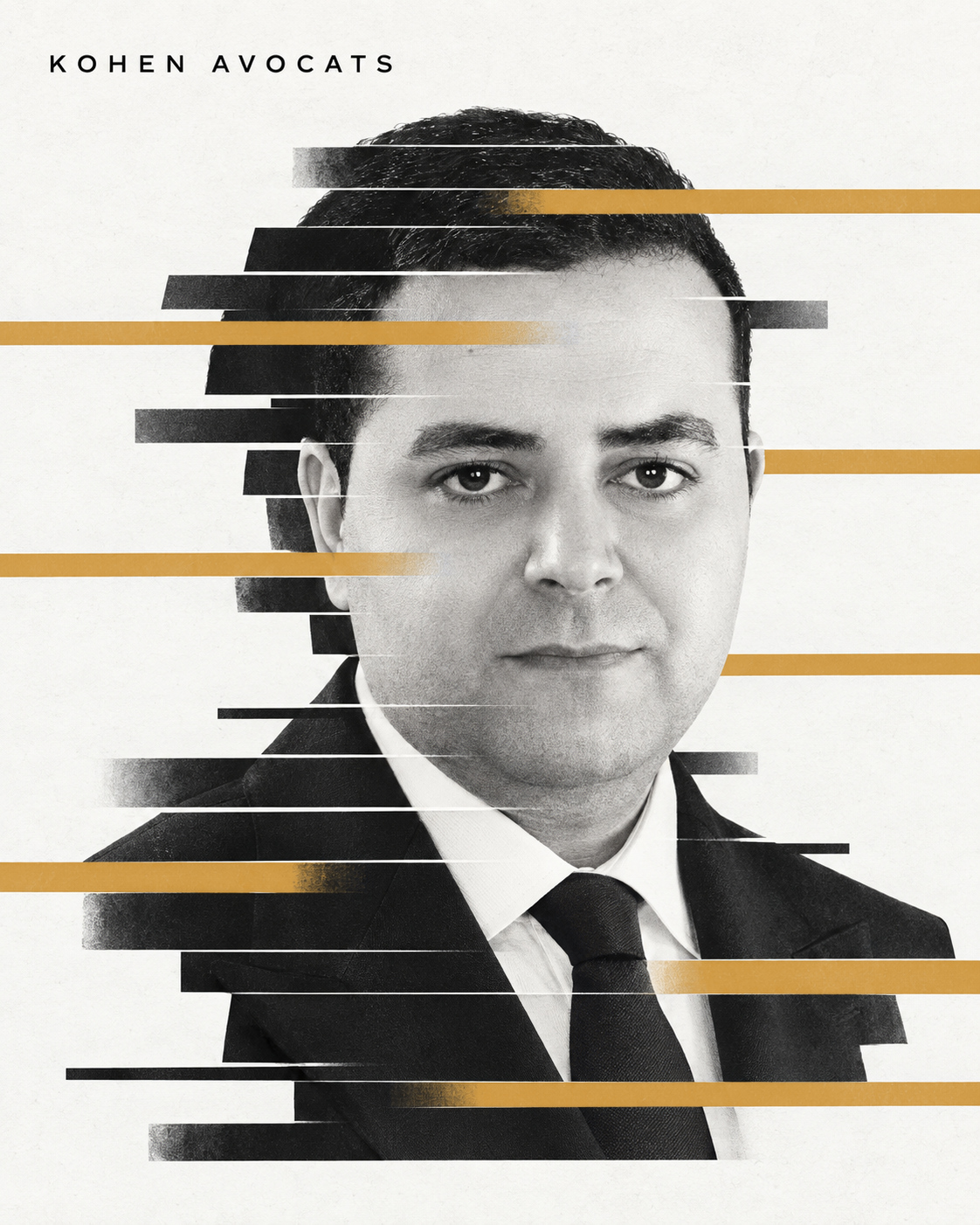
Reda Kohen, a lawyer at the Paris Bar, acts for businesses that need to choose, use or defend a trademark, from choosing the name through to litigation.
A small business often discovers the value of its trademark at the moment it believes it to be under threat. The firm then examines three questions in order: is the sign valid, does it belong to the right person, and can use of it be proved?
Ownership of a trademark arises from registration, for a renewable period of ten years (Article L. 712-1 of the French Intellectual Property Code). A company name, a shop sign or a domain name do not confer the same right: they can stand in the way of a later trademark, but on narrower conditions than registration.
Send what you have, even if incomplete: the firm will prioritise and complete the file with you. In an emergency, call +33 6 46 60 58 22.
Official profile in the directory of French lawyers (CNB)Firm at 11 rue Margueritte, 75017 Paris
Choosing a defensible name
A sign too close to a description of the product, or already used by another business, weakens the whole commercial strategy built around it.
Using it to keep it
Five years without genuine use or proper reasons, counted at the earliest from registration, expose the mark to revocation and can make an infringement action inadmissible: evidence of use is built up over the course of the business.
Defending it without putting yourself in the wrong
A badly targeted warning letter, excessive tolerance or an ill-founded action can turn against the proprietor itself.
The rules
Choose, use, defend: the rules that apply
Five rules shape the life of a business trademark, from its creation to its first dispute.
- A trademark must not encroach on an earlier company name, nor on a trade name, shop sign or domain name known beyond a purely local setting, where the public risks confusing the signs (Article L. 711-3 of the CPI). Ruling under the earlier wording of these provisions, the Court of Cassation (Cour de cassation) held that “the proprietor of an earlier right may bring an action for nullity of the registered mark if there is a risk of confusion in the mind of the public, even where the proprietor of the challenged mark holds a right older than that of the third party challenging it” (our translation) (Cass. com., 10 January 2024, No. 22-21.716).
- The chosen sign must allow the customer to identify the business: a name that merely describes a quality or intended purpose of the product is null, unless use has given it that capacity (Article L. 711-2). Even when maintained, a weak mark protects little: for a European Union trademark, the Paris court of appeal held that the consumer, “given the weakly distinctive character of all the word elements contained in the signs at issue, will turn their attention to the graphic elements of the signs” (our translation), and rejected infringement (CA Paris, pôle 5 ch. 1, 11 June 2025, No. 23/17122).
- The proprietor faces revocation if it has not made genuine use of its mark for five years, and it is for the proprietor to prove use (Articles L. 714-5 and L. 716-3-1). The Versailles court of appeal upheld the total revocation of a perfume trademark whose documents “do not make it possible, in the absence of any evidence of genuine availability of the products to the public, to characterise genuine use of the mark” (our translation) (CA Versailles, ch. com. 3-1, 5 March 2025, No. 23/05640).
- A mark that has become, through its proprietor's own conduct, the common designation of the product is lost (Article L. 714-6). The Court of Cassation approved a revocation, noting that “through its inactivity, Tennis d'Aquitaine contributed to the degeneration of its mark” (our translation), despite use of the ® symbol and a few formal notices (Cass. com., 13 November 2025, No. 24-14.449).
- Anyone who knowingly allows a more recent registered mark to be used for five consecutive years loses the right to have it annulled or to bring proceedings against it, except where the filing was in bad faith (Articles L. 716-2-8 and L. 716-4-5). Under the earlier provision, the Court of Cassation clarified that “Proof that the proprietor of the earlier mark knew of the use of the later mark after its registration may result from general knowledge, in the economic sector concerned, of such use” (our translation) (Cass. com., 5 June 2024, No. 23-15.380).
A registration is not permanent protection: a mark is lost through lack of use or through inaction in the face of generic uses, and excessive tolerance closes off certain actions against a more recent mark.
Your documents
The documents that help, depending on your situation
Ownership, date and evidence of use form the foundation of every trademark file.
Situation A
You are launching or using the mark
- Filing notice, registration certificate and the exact wording of the goods and services covered
- Articles of association, Kbis extract (extrait Kbis) and documents showing who filed: the company, the director or a shareholder
- Dated invoices, catalogues, website pages and advertisements showing the mark on the products sold
- Prior-rights searches carried out, domain names reserved and shop signs already in use
Situation B
A dispute has started or is looming
- Formal notice, opposition, writ of summons or letter received, with its date of receipt
- Dated screenshots of the opposing sign, its products, its website and its social media
- Timeline of when you became aware of the opposing sign: first contact, trade fairs, shared customers
- Turnover achieved under the mark and material allowing loss to be assessed
Do not write to a competitor's customers or distributors before your rights have been checked: a premature warning may be characterised as disparagement.
The firm also handles:
- Intellectual property
- Trademark filing
- Domain name
- Industrial property
The method
How the firm examines your trademark
Check the right, link it to the right person, then choose a proportionate response.
Step 1
Reviewing the title and ownership
The firm checks the certificate, the wording, the filing date and the name of the applicant, then compares these against the reality of the business that uses the sign.
Step 2
Checking validity and prior rights
Distinctiveness, earlier rights, company names, shop signs and domain names are examined to gauge the strength of the sign before any investment or action.
Step 3
Building the evidence of use
Documents showing use are sorted by five-year period and by product, in order to answer a revocation claim or a plea of inadmissibility.
Step 4
A response suited to the dispute
Depending on the file, the firm may act by a targeted formal notice, an opposition, an application to the National Institute of Industrial Property (INPI), an infringement seizure (saisie-contrefaçon) or an action before the competent judicial court (tribunal judiciaire).
A trademark that looks solid on paper may prove fragile before a judge if nobody has kept a record of its actual use.
The timetable
The time limits that mark the life of a trademark
Some deadlines are set by the Code, others arise from the conduct of the parties.
Publication of the application
Two months. The proprietor of an earlier right listed by law has two months from publication to file an opposition with the INPI (Articles L. 712-4 and L. 712-4-1 of the CPI).
Claiming a fraudulent filing
Five years. The claim must be brought within five years of publication, except where the applicant acted in bad faith (Article L. 712-6 of the CPI).
Genuine use
Five years. An uninterrupted period of five years without genuine use or proper reasons, running at the earliest from registration, exposes the proprietor to revocation and may make its infringement action inadmissible (Articles L. 714-5 and L. 716-4-3 of the CPI).
Tolerance of a competing mark
Five years. Five years of knowing tolerance bar the nullity action and the infringement action against a later mark registered in good faith.
Infringement action
Five years. The five-year period runs from the date on which the proprietor knew, or should have known, of the last act complained of (Article L. 716-4-2 of the CPI).
Renewal
Ten years. Protection lasts ten years from filing and may be renewed an unlimited number of times (Article L. 712-1 of the CPI).
The checks
What the firm checks before acting
A trademark action is prepared on documents, never on the mere impression of a resemblance.
- Ownership: is the mark registered in the name of the company that uses it, the director or a third party, and is that position documented?
- Validity: is the sign distinctive for the goods concerned, and does no earlier right threaten its registration?
- Use: do the documents cover each product relied on over the five relevant years, with verifiable dates and volumes?
- Past conduct: since when has the opposing sign been known, has it been tolerated, and have letters already been sent to third parties?
- Basis of the action: infringement, nullity, revocation, claim to ownership, unfair competition or parasitism, each with its own conditions.
Summary
Situation, evidence, first response
Common SME situations help to set the priority of the file.
Situation
The director filed the mark in their own name
Decisive evidence: Registration certificate, articles of association, minutes and agreements between the company and its director.
Time limit: A claim to ownership is limited to five years after publication, except in cases of bad faith.
Useful action: Arrange a written assignment or licence, or consider a claim to ownership if fraud can be shown.
Situation
A competitor files a name close to yours
Decisive evidence: Kbis extract, first invoices, dated website and shop sign, proof that the applicant knew of your name.
Time limit: Opposition within two months of publication, nullity thereafter.
Useful action: Opposition before the INPI, an application for nullity or a claim to ownership, depending on the earlier rights available.
Situation
Your mark is little used or not used at all
Decisive evidence: Invoices, catalogues, advertisements and sales figures linked to each registered product.
Time limit: The five years preceding the revocation application, or preceding the infringement action where the defendant challenges use.
Useful action: Resume real, documented use without delay: use resumed within the three months preceding an announced revocation application may be neutralised (Article L. 716-3 of the CPI).
Situation
Your name is becoming a common term in the sector
Decisive evidence: Records of generic use by competitors, the press and professional customers.
Time limit: Each year of inaction increases the risk of revocation.
Useful action: Measured written reminders, corrections requested from third parties and, if need be, targeted actions.
Situation
A copy is discovered online or in a shop
Decisive evidence: Dated reports, test purchases, screenshots of the website and social media, volume figures.
Time limit: Five years to act, but prolonged tolerance closes off certain routes.
Useful action: Formal notice to the copier, infringement seizure if necessary, then an action on the merits.
Situation
You are accused of infringement
Decisive evidence: Date of your first uses, searches carried out, evidence that the claimant knew of your use.
Time limit: Reply quickly to prepare the defence and preserve your own evidence, as an ex parte measure remains possible.
Useful action: Challenge the opponent's genuine use, rely on tolerance, or bring an application for revocation or nullity.
Frequently asked questions
Your questions: business trademarks
Should the trademark be filed in the director's name or in the company's name?
The proprietor of a trademark is the person in whose name it was registered, under Article L. 712-1 of the CPI. Where the manager alone files the name of the shop sign used by their company, they become the proprietor, and the company is merely a user for as long as no contract governs the position. In the event of a falling-out or a sale of the business, this mismatch weighs heavily. The company may claim the mark if the filing was made in fraud of its rights, but Article L. 712-6 limits the action to five years after publication, except where the applicant acted in bad faith. Proof of fraud remains demanding: in 2023, the Paris court of appeal held that “Mere knowledge of the earlier right or simple negligence is not enough to establish bad faith; an intention to harm the proprietor of earlier rights must also be shown” (our translation) (CA Paris, pôle 5 ch. 1, 19 April 2023, No. 21/06272). Since bad faith was not established, the company's request for transfer was dismissed as time-barred, and the operating companies were held liable for infringement towards the director who held the mark. Since then, the Court of Cassation has clarified that bad faith is assessed on objective indicia gathered at the filing date and that it “does not require, in order to be established, that a particular third party be targeted” (our translation) (Cass. com., 13 November 2025, No. 24-14.355). The firm therefore checks, as soon as the company is created or on a fundraising, who actually holds the mark, and then proposes a suitable written assignment or licence.
Is our company name enough to protect the business name?
Registration gives a right in the company name, but that right is not equivalent to a trademark. It allows the company to oppose a later mark, or to seek its nullity, only if the public risks confusing the two signs, as provided by Article L. 711-3 of the CPI, 3°. The Court of Cassation accepted this for the benefit of regional companies whose acronym had been filed as a trademark by a sister company. Under the earlier wording of the Code, it held that “the proprietor of an earlier right may bring an action for nullity of the registered mark if there is a risk of confusion in the mind of the public, even where the proprietor of the challenged mark holds a right older than that of the third party challenging it” (our translation) (Cass. com., 10 January 2024, No. 22-21.716). This protection is assessed by reference to the activities actually carried on. It does not allow a trademark infringement action against a competitor who uses the same name for related products, but wrongdoing by that competitor may support an unfair competition action under Article 1240 of the French Civil Code (Code civil). The firm therefore examines whether the company name is sufficient for the current business, or whether a filing is needed before a geographic expansion, a new range or the arrival of investors.
Does a shop sign used for years protect against a trademark filed by a third party?
A shop sign, trade name or domain name can stand in the way of a later trademark, but only if it is known beyond a local setting and the public risks confusing the signs, under Article L. 711-3. Proving that reach is often difficult for a neighbourhood business. In a dispute concerning a European Union trademark, the Paris judicial court (tribunal judiciaire) held that the trader relying on its earlier signs did not show that they had any reputation beyond the local: “Plein Tubes provides no evidence that it enjoys a recognition extending beyond the local setting” (our translation) (TJ Paris, 3e ch. 3e sect., 19 March 2025, No. 22/05128). Examining nullity under the provision in force at the time of the 2017 filing, the court dismissed the application and held the trader liable for infringement, with a ban on using the sign for the goods covered by the mark, even though it relied on use of the name since 1986. Article L. 713-6 nevertheless preserves earlier use of a sign of local reach, within the limits of the territory where it is recognised. The firm assesses with you the invoices, the customer base outside the town and the online visibility before choosing between negotiation, defence or a prompt filing.
Can a name that describes the product become a useful trademark for an SME?
A descriptive name reassures the customer because it explains what is being sold, but it protects the business poorly. Article L. 711-2 of the CPI excludes signs that merely describe a characteristic of the product, unless use has made them distinctive. Even where the registration survives, the protection remains narrow. In a dispute concerning a European Union trademark, the Paris court of appeal upheld the sign but rejected infringement, holding that the consumer, “given the weakly distinctive character of all the word elements contained in the signs at issue, will turn their attention to the graphic elements of the signs” (our translation) (CA Paris, pôle 5 ch. 1, 11 June 2025, No. 23/17122). In that case, very similar word signs were able to coexist, given their weak distinctiveness and the differences in structure and overall presentation. For an SME, choosing an arbitrary or suggestive term avoids this trap and makes later defence easier. The firm can review several name options against the goods concerned before the commercial materials are printed.
How can evidence that the mark is used be kept over the years?
Article L. 714-5 of the CPI penalises the absence of genuine use for five years, for each product or service covered, with revocation. Article L. 716-3-1 places the burden of proving use on the proprietor, who may do so by any means. Plans, prototypes and presentations are not always enough. The Versailles court of appeal upheld the revocation of a perfume trademark, finding that the documents produced “do not make it possible, in the absence of any evidence of genuine availability of the products to the public, to characterise genuine use of the mark” (our translation) (CA Versailles, ch. com. 3-1, 5 March 2025, No. 23/05640). The health difficulties relied on were not accepted as proper reasons for non-use. An SME is therefore well advised to keep, every year, invoices, catalogues, dated website pages and advertisements showing the mark on the products actually sold. The firm can organise this filing by product and by period, so that the evidence is ready the day a competitor applies for revocation before the INPI.
Can a copier be sued with a mark that is little used?
The defendant in an infringement action may require the proprietor to prove genuine use of its mark during the five years preceding the claim, for the goods relied on. Failing that, and unless there are proper reasons, the action is inadmissible under Article L. 716-4-3 of the CPI. The Paris judicial court applied this rule to real estate services, recalling that “Genuine use of the mark must be established for each of the goods or services covered by its registration and targeted by the infringement claim” (our translation) (TJ Paris, 3e chambre 1re section, 18 December 2025, No. 23/13626). A simple sales brochure was not enough, and the mark was also declared revoked for all goods and services. The action brought to protect the name therefore led to its loss. Before issuing a writ of summons, the firm checks the evidence of use product by product and assesses the risk of a counterclaim. It may then advise limiting the action to the goods actually used, or basing the claim on another right, such as unfair competition.
Our trademark is becoming a common word in the sector: can it still be saved?
Under Article L. 714-6 of the CPI, the proprietor loses its rights where the mark has become, through its own conduct, the common designation of the product in the trade. The proprietor's conduct includes its inaction in the face of generic uses. The Court of Cassation approved the revocation of a mark designating multi-sport courts, noting that “through its inactivity, Tennis d'Aquitaine contributed to the degeneration of its mark” (our translation) (Cass. com., 13 November 2025, No. 24-14.449). The proprietor did affix the ® symbol and had sent three formal notices, which the judges found insufficient given the many uses identified. This risk mainly concerns SMEs that have created a new product and whose name took hold before the competition. The response must be regular and measured: written reminders to distributors, requests for correction to publishers and local authorities, selective actions where the use persists. The firm can draw up a record of uses and prioritise the steps to take.
A competitor has registered our name to block us: what can be done?
A filing made in bad faith is a ground of nullity under Article L. 711-2, 11°, and Article L. 712-6 gives a claim to ownership to anyone who considers they have a right in the mark. In a case concerning closures, the Court of Cassation quashed the judgment that had ruled out bad faith on the part of a company that had filed a sign already used by a third party. It held that “bad faith does not require, in order to be established, that a particular third party be targeted” (our translation) (Cass. com., 13 November 2025, No. 24-14.355), and criticised the judges for not examining whether the applicant intended to use the mark. The wish to protect a family name was not, on its own, enough to rule out bad faith. For an SME, the evidence rests on objective indicia gathered at the filing date: knowledge of earlier use, absence of use, later formal notices. The firm reconstructs this timeline and chooses between nullity, a claim to ownership and negotiating an assignment.
Does waiting several years before reacting to a similar mark mean losing your rights?
Yes, beyond five years of knowing tolerance. Articles L. 716-2-8 and L. 716-4-5 of the Intellectual Property Code bar the nullity action and the infringement action against a later registered mark whose use has been tolerated for five consecutive years, except where the filing was in bad faith. The decisive question then becomes the date on which the proprietor learned of that use. In a school supplies case decided under the earlier provision, the Court of Cassation held that “Proof that the proprietor of the earlier mark knew of the use of the later mark after its registration may result from general knowledge, in the economic sector concerned, of such use” (our translation) (Cass. com., 5 June 2024, No. 23-15.380). The presence of the products on the same supermarket shelves was enough to establish that knowledge, and the proprietor of the earlier mark lost its action. An SME that discovers a similar sign must therefore record the date of its discovery and decide quickly how to react. The firm can help you weigh a coexistence agreement, opposition, nullity or an action.
Can you warn a competitor's customers that it is selling copies?
The temptation is strong to write to resellers to encourage them to withdraw the products at issue. The risk is real: informing third parties of an infringement that no judge has yet found can make the author liable under Article 1240 of the French Civil Code (Code civil). In a case concerning copyright, the Court of Cassation held that “the mere fact of informing third parties of a possible infringement of those rights constitutes disparagement of the products alleged to infringe” (our translation) (Cass. com., 23 September 2026, No. 22-23.833). It quashed the judgment that had considered the letters sent to the targeted company's partners to be legitimate. That decision does not directly concern trademarks, but it calls for caution in any approach to a competitor's customers. A formal notice sent to the copier alone remains the ordinary route. Before any contact with distributors, the firm examines the strength of the rights and the risk of disparagement, because a measured tone is not enough to rule out that risk while no decision has found the infringement.
If trademark infringement is ruled out, is there still an action against the copier?
Yes, where the competitor's conduct is wrongful. An action for unfair competition or parasitism rests on Article 1240 of the Civil Code and not on an exclusive right. The Court of Cassation recalls that “economic parasitism is a form of disloyalty, constituting wrongdoing, which consists, for an economic operator, in placing itself in the wake of another in order to profit unduly from its efforts, its know-how, its acquired reputation or its investments” (our translation) (Cass. com., 18 March 2026, No. 24-17.016). In that same judgment, it now held that such claims pursue the same ends as the infringement action where they rest on the same facts. A party whose infringement action was rejected for lack of an exclusive right, here because its trademarks had been annulled, can therefore bring a parasitism claim based on the same facts for the first time on appeal; the case was referred back to the Versailles court of appeal. The two actions may also be combined if they concern distinct facts: the Court held that “Facts committed in different periods are distinct facts” (our translation) (Cass. com., 13 November 2025, No. 24-14.355). The firm can build the writ of summons by distinguishing from the outset the acts that fall under trademark law from those that fall under wrongdoing.
Should you go to the INPI or to the court to bring down an obstructive trademark?
Article L. 716-5 of the CPI reserves to the INPI applications for nullity based on absolute grounds and on several earlier rights, notably a trademark, a company name or a shop sign, as well as applications for revocation for non-use or degeneration. Other actions, and in particular infringement, fall to the specialised judicial courts designated by decree. The court again becomes exclusively competent for nullity or revocation where those applications are connected to another claim within its jurisdiction, notably an infringement or unfair competition action, or where evidentiary, interim or protective measures ordered to stop an infringement of the trademark are being carried out before an action on the merits is brought. An action for nullity is subject to no limitation period under Article L. 716-2-6, subject to tolerance and to the five-year period running from registration imposed on the proprietor of a well-known mark, except where the filing was in bad faith (Article L. 716-2-7). For an SME, the choice between the INPI and the court therefore depends on the ground relied on and on the other claims brought or contemplated. The firm examines the ground available and the most suitable procedural route.
How can evidence of a copy be gathered and the loss assessed?
Infringement may be proved by any means. Article L. 716-4-7 of the CPI also allows an infringement seizure (saisie-contrefaçon) to be obtained from the judge on application: a detailed description or actual seizure of the products and documents, by a court bailiff (commissaire de justice), who may be assisted by an expert. If the action on the merits is not brought within the regulatory period, the seizure is annulled at the request of the person seized. As to loss, Article L. 716-4-10 requires the judge to take separate account of losses and lost profits, non-pecuniary loss and the infringer's profits. Alternatively, and at the request of the injured party, the judge may award a lump sum higher than the royalties that would have been due, without excluding compensation for non-pecuniary loss. In the closures case already cited, the Court of Cassation left it to the lower courts to assess, in their sovereign discretion, non-pecuniary loss including damage to image, under unfair competition and in the absence of proven loss, while quashing the infringement award. The firm therefore gathers dated reports, test purchases and sales data to quantify each head of loss before acting. A serious assessment from the outset also makes it possible to weigh the benefit of a settlement against the cost of lengthy proceedings.
Sources and related pages
Official texts and related pages
The sources for this page and the firm's related areas of practice.
Further reading
Page updated on 1 November 2026.
A trademark to choose, secure or defend? Take stock of your rights.
Send the title, the articles of association and a few dated proofs of use: the firm checks ownership, validity and the response suited to your situation.
The latest news.
What our clients say
Best real estate law and business law lawyer in Paris. A humane and attentive lawyer, with a wonderful team. Thank you, Maître KOHEN
Translated from French
Thank you to Maître KOHEN for his analyses of recent case law on fraudulent non-disclosure in property sales. It reassures me about an action for annulment that I am considering after buying a house affected by serious defects intentionally concealed by the seller and not reported by the estate agent; also defects (rising damp) characterised by spreading through-cracks and damp stains, not reported by the estate agent… Worse, defects concealed by the latter or at his instigation, under a coat of paint and by polystyrene tiles glued to the ceiling of a bedroom. And the said estate agent drafted the preliminary contract, which of course contains no information about any of these defects. Just to add that, being 77 years old and suffering from cognitive impairment, I am certain that the estate agent thought I would not be able to discover the deception and above all to establish the fraudulent intent, still less to bring legal proceedings given the complexity and length of the procedure... That is why I am opting for the criminal route, insofar as the intentional concealment of the defects by the seller and then by the estate agent amounts to the fraudulent manoeuvres of art. 313-1 of
Translated from French
Maître Reda KOHEN assisted me in a dispute concerning a sale agreement with a defaulting party. He provided professional and responsive support, and I highly recommend him.
Translated from French
I highly recommend Maître Reda Kohen. Thanks to his explanations, I was able to recover my security deposit in a situation that seemed blocked. He was responsive, clear, and very professional. A big thank you for his invaluable help!
Translated from French
Excellent support from Maître Kohen in a case combining business law and real estate law. Clear legal analysis from the first meeting, right through to the hearing. Professional and accessible lawyer, I highly recommend his firm in Paris 17.
Translated from French
Maître Kohen assisted me in recovering unpaid debts from a defaulting tenant. Procedure mastered from start to finish, from the payment order to eviction. Human, attentive, and always reachable. Thank you for your work.
Translated from French
As a young student living in an apartment, my landlord tried to make me leave my accommodation even though he had sent me no termination notice. I therefore contacted Mr. Reda Kohen to help me as I couldn’t handle the situation alone. In just 3 days everything was resolved, Maître Kohen defended me and accompanied me with an irreproachable level of commitment and efficiency. I can only recommend his professionalism!
Translated from French
I turned to Maître Kohen for a complex real estate dispute and I highly recommend his firm. He is very professional; he thoroughly analyzed my case from the very first appointment and clearly explained the possible options. Thanks to his expertise, we achieved a very favorable outcome. Responsive, a good teacher, and committed, he is a lawyer you can truly trust. Yours faithfully, Miss Maazaz
Translated from French
Very satisfied! I would like to thank Maître Esther Cornu here, who managed to resolve a very complicated dispute in a divorce and family law matter...Thanks to Maître Cornu, a judgment was handed down in my favour even though it was far from a foregone conclusion...So I recommend this law firm
Translated from French
A precise and concrete analysis and an immediate response. Excellent.
Translated from French
I highly recommend this lawyer for his professionalism, honesty, and transparency. He helped me successfully and guided me through the process with great care and expertise. What I particularly appreciated was his honest approach and the fact that he recommended practical, cost-effective options instead of immediately pushing for the most expensive solution. He genuinely focused on finding the right approach for my situation. I’m very grateful for his support and would definitely recommend him to anyone looking for a trustworthy and professional lawyer in France.
Thank you for this detailed, precise help, with a proposal at the end on whether or not to continue (very quick response as well)
Translated from French
Very good advice given by Maître Cornu during our meeting on 16 October.
Translated from French
Very professional and responsive service. The lawyer quickly and carefully checked the validity of my wife’s residence permit in light of a specific legal regime. His work gave us clarity, whereas the usual administrative procedures were long and ambiguous. I appreciated his efficiency and professionalism, and I recommend his services.
Translated from French
I would like to warmly thank Maître Esther Cornu for her professionalism, her availability and the quality of her support. In a case of particular importance for my professional future, she showed great responsiveness, rigour and a gift for explaining things, taking the time to answer my questions precisely and to explain the various legal steps to me. I particularly appreciate the clarity of her analyses, her seriousness and her commitment in following up my case. Many thanks to Maître Esther Cornu for listening and for her support. I highly recommend!
Translated from French
I was pleasantly surprised by the responsiveness of Mr Reda Cohen, who took the time to answer my questions about my case instantly. It has become so rare these days to find a lawyer who is so available, responsive and attentive, even when it is simply a matter of answering questions. His answers are clear, precise and reassuring. You can tell that he takes the time to understand the situation and to provide relevant answers. Beyond his excellent ratings on Google, it is above all this availability and this seriousness that make the difference. Many thanks to Mr Reda Cohen for his professionalism and his responsiveness. I highly recommend!
Translated from French
A huge thank you to Maître Esther Cornu from Kohen Avocats for her support during a particularly difficult time. Her attentiveness, empathy, and humanity touched me deeply. She was able to answer my questions with clarity and sensitivity, while demonstrating great professionalism and fully respecting the confidentiality of the case. Beyond her professional qualities, I met a deeply humane lawyer whose support made a real difference. I sincerely recommend her.
Translated from French
Good experience. And good work, thank you for everything.
Translated from French
Saw Hassan on the TV news
Translated from French
very clear article
Translated from French
Loading…
Your cookies
We use cookies to measure the effectiveness of our campaigns and improve the site. You can change your choice at any time.