Failed project, ERP, bespoke software, application: expert assessment, termination, quantifying loss
IT litigation lawyer in Paris: failed projects, court-appointed expert assessment, termination and quantifying loss.
An ERP that never goes live, an application delivered unusable, a bespoke development abandoned midway: as an IT litigation lawyer in Paris, the firm sees these disputes decided on three grounds in turn. Technical evidence first, often through an expert assessment. The fate of the contract next, between continuing and termination. The amount last, restitution and damages, item by item.
Before uninstalling the solution, handing the recovery to another provider or serving notice of termination, keep the delivered versions, the access credentials and the project correspondence: a modification or an uninstallation can compromise the examination of the system's initial state.
IT litigation · Paris
Get a first analysis
Send the contract, its functional appendices, the schedules, the steering committee minutes, the tickets and the latest correspondence: the firm reviews the available evidence, the available routes out of the contract and the sums that can be claimed.
24 à 48 h
first legal
review

Kohen Avocats, Paris 17
Failed IT project: what wins or loses the case
Digital law · Paris 17th
What an IT litigation lawyer in Paris does
- Paris Bar
- Digital law
- IT project litigation
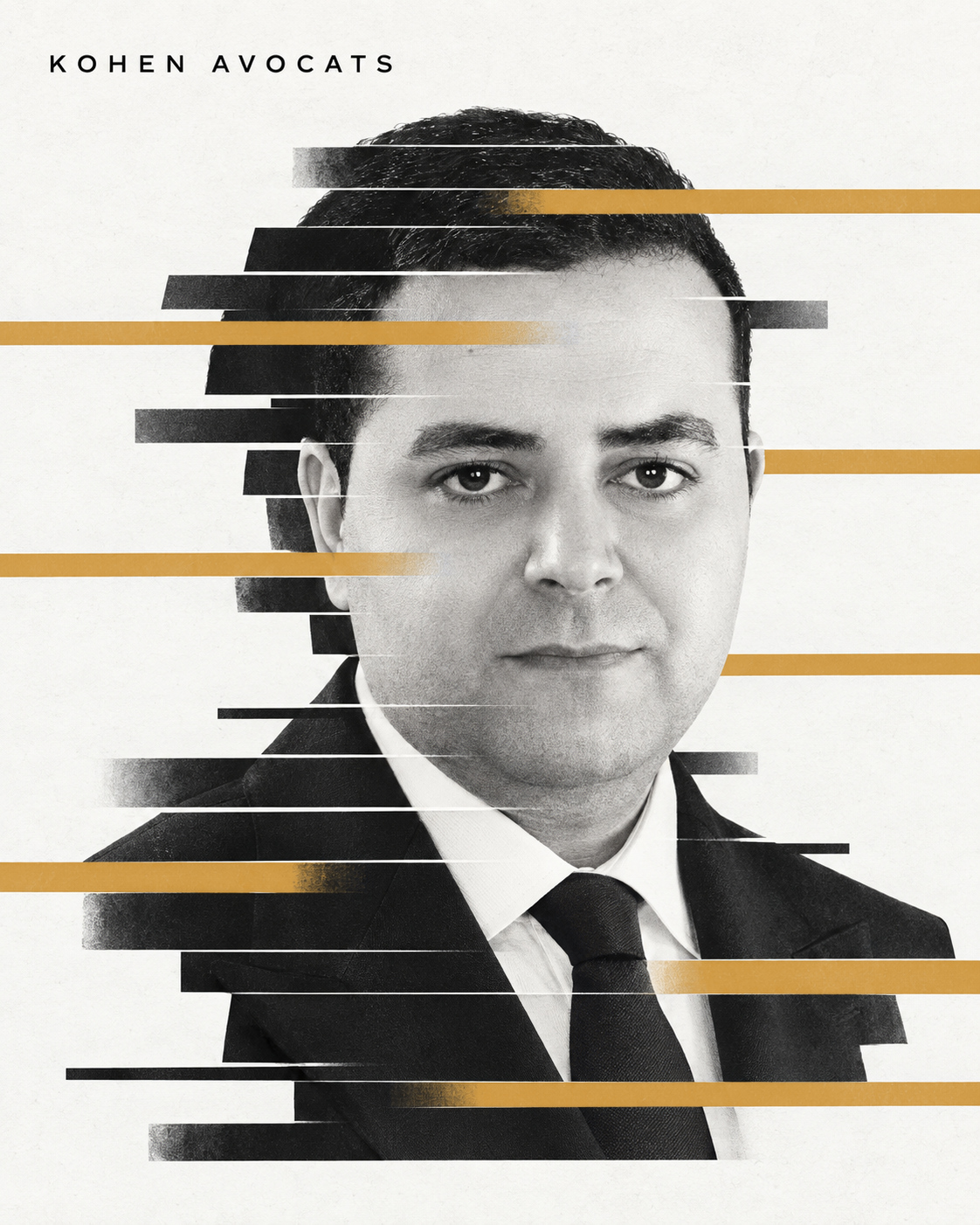
Reda Kohen, lawyer (avocat) at the Paris Bar, can act in disputes arising from failed IT projects: software package integration, bespoke development, mobile applications, platforms or management software.
The firm can act for the client company as well as for the software publisher or services company. It first examines what the contract promised, what the deliverables show and what each party did or failed to do during the project.
The strategy follows a precise order: establish the technical evidence, choose the fate of the contract, then quantify the loss. A poorly framed expert assessment, a termination served too early or a loss asserted without sufficient documents can overturn a case that is otherwise strong on the merits.
Send what you have, even if incomplete: the firm will prioritise and complete the file with you. In an emergency, call +33 6 46 60 58 22.
Official profile in the directory of French lawyers (CNB)Firm at 11 rue Margueritte, 75017 Paris
Technical evidence
An expert's brief drafted around the real points of disagreement, the deposit paid into court on time, written observations filed during the expert's operations: an expert assessment is prepared like proceedings.
The fate of the contract
Judicial termination, termination clause or notice of termination at the creditor's own risk: each route has its conditions, and an unjustified termination is paid for in damages.
Quantifying the loss
Restitution on one side, loss on the other: sums to be returned are justified by the payments made and services exchanged, and each head of loss by its own documents and by its link with the non-performance found.
The rules
Expert assessment, termination, restitution: the rules that decide
Four rules govern the exit from a failed IT project.
- Evidence before trial rests on Article 145 of the French Code of Civil Procedure (Code de procédure civile): the judge may order a measure of inquiry on application or in urgent proceedings where there is a legitimate reason to establish or preserve facts relevant to a future dispute. In an ERP replacement whose go-live had slipped, the president of the Paris economic activities court (tribunal des activités économiques) instructed the expert to "state whether the deadlines as contractually set could or could not technically be met" (our translation) (TAE Paris, réf., 24 January 2025, No. 2024046137).
- Termination follows Article 1224 of the French Civil Code (Code civil): a termination clause, notice from the creditor where the non-performance is sufficiently serious, or a court decision. Outside cases of urgency, notice requires a prior formal notice announcing termination, and the creditor bears the burden of proving seriousness if the debtor disputes it (Article 1226 of the Civil Code). The Court of Cassation penalises a termination "from which it followed that the termination was unjustified and not merely abrupt" (our translation) where no serious non-performance is established (Cass. com., 29 January 2025, No. 23-17.795).
- Restitution depends on the usefulness of the services: a solution that was only worth anything once completed gives rise to full restitution; if the services were useful as the contract was performed on both sides, nothing is returned for the period preceding the last service left without consideration (Article 1229 of the Civil Code). The Court of Cassation holds that "the acceptance of shared fault does not preclude restitution" (our translation) in a dispute over a white-label mobile application (Cass. com., 15 May 2024, No. 23-13.990).
- Damages cover the loss suffered and the profit lost (Article 1231-2 of the Civil Code), within the limit of what could have been foreseen when the contract was concluded, except in cases of gross negligence or wilful misconduct (Article 1231-3 of the Civil Code). The Toulouse court of appeal recalls that "gross negligence is characterised by conduct of extreme seriousness bordering on wilful misconduct" (our translation) and ruled out that characterisation for lack of supporting documents (CA Toulouse, 2e ch., 25 November 2025, No. 23/02664).
Restitution is not compensation: restitution puts the parties back in their previous position, whereas damages require a proven loss tied to a specific fault.
Your documents
The documents to gather depending on your side of the project
The same project produces two opposing cases: only dated documents decide between the versions.
Position A
You are the client company
- Contract, functional appendices, commercial proposal and successive amendments or purchase orders
- Schedules, steering committee minutes, tickets opened and the answers received
- Delivered versions, test environments, access credentials and technical logs preserved as they stand
- Paid invoices, internal time records, quotes or invoices from the replacement provider
Position B
You are the software publisher or integrator
- Reminders sent to the client, data or approvals awaited and left unanswered
- Out-of-scope change requests, quotes proposed and any refusals
- Incident tracking tables with opening and closing dates
- Termination letter received, formal notice missing or incomplete, invoices left unpaid
Do not cut off access, migrate data or destroy any environment until a bailiff's report or an expert assessment has fixed the state of the system.
The firm also handles:
- IT contracts
- Court-appointed expert assessment
- Termination clause
- Economic loss
The method
How the firm handles the case
A four-step sequence, from securing the evidence to the final quantification.
Step 1
Reconstructing the project
The firm arranges the documents by date, distinguishes contractual commitments from mere exchanges and identifies the points at which the project tipped.
Step 2
Framing the technical evidence
A bailiff's report, an adversarial audit or a court-appointed expert assessment: the choice depends on what is disputed. If an expert assessment is necessary, the firm proposes a precise brief on causes, attribution and costs.
Step 3
Choosing the fate of the contract
Continuing with a deadline, termination by the judge or notice after formal notice: the firm checks the termination clause, the seriousness that can be demonstrated and the risk of a termination being held unjustified.
Step 4
Quantifying and negotiating
Restitution, replacement cost overrun, lost margin: each item is tied to a document. The quantified case also serves as a basis for a settlement where the parties have an interest in one.
An inflated claim weakens the serious claim: judges readily set aside items asserted without supporting documents, even where the provider's fault is established.
The timetable
How a failed project unfolds before the judge
From the first delays to the judgment on restitution and loss.
Delays and defects
From the first slippages. Record in writing every blocking defect, every reminder and every missed delivery date.
Securing the evidence
Preserve versions, access credentials and environments; have the state of the system recorded before any takeover by a third party.
Formal notice
List the breaches, set a reasonable deadline and, where appropriate, announce termination in the absence of performance.
Expert assessment
Application under Article 145, payment of the deposit into court, meetings, written observations, then the report.
Action on the merits
Termination or performance, restitution and damages, supported by the report and the accounting documents.
Decision or agreement
The judge decides the fate of the contract, restitution and compensation; a settlement can be reached at any stage.
The checks
What the firm checks before any termination
A badly prepared termination turns the creditor into a debtor.
- Actual scope: what the contract, its appendices and the committee approvals required, and what amounted to changes to be invoiced.
- Demonstrable seriousness: blocking defects, repeated delays, an unusable solution, established by documents and not by impressions.
- Formalities: termination clause, formal notice announcing termination, reasonable deadline, whether or not there is a genuine urgency.
- Client cooperation: answers to reminders, data supplied, contacts available throughout the project.
- Quantification: sums paid, replacement costs, internal time and operating losses, each supported by a document.
Summary
Situation, evidence, exit
Six common configurations and the first priority in each.
Situation
ERP whose go-live is repeatedly postponed
Decisive evidence: Successive schedules, minutes, items expected from the client and whether they were supplied.
Timing: Act before a takeover by a third party makes examination impossible.
Useful action: Expert assessment on deadlines, causes and attribution, then a decision on the contract.
Situation
Turnkey software delivered incomplete
Decisive evidence: Contract describing an operational solution, report of a partial migration, requests for additional payment.
Timing: Serve formal notice as soon as completion is made conditional on a new quote.
Useful action: Judicial termination and restitution of the sums paid if the solution is of no use.
Situation
Bespoke development that is unusable
Decisive evidence: Technical audit, absent tests, incomplete documentation, documented deployment failures.
Timing: Serve notice of termination only after the formal notice provided for in the contract.
Useful action: Termination clause, restitution of deposits and defence against the provider's invoices.
Situation
Mobile application never put online
Decisive evidence: Contractual timetable, user feedback, delays attributable to each party.
Timing: Assess your own share of the delay early, before terminating.
Useful action: Restitution of the deposit despite shared fault, then allocation of responsibility.
Situation
Client who terminates without formal notice
Decisive evidence: Reminders left unanswered, incidents closed, absence of urgency.
Timing: Challenge the termination quickly and claim the invoices due.
Useful action: Have the termination held unjustified and obtain compensation for the lost profit.
Situation
Alleged operating loss
Decisive evidence: Accounts, margins, internal time recorded, replacement quotes, opinion of a chartered accountant.
Timing: Gather the accounting documents during the expert assessment, not after the report.
Useful action: Item-by-item quantification, with a financial assistant expert (sapiteur) if the brief provides for one.
Frequently asked questions
Your questions: IT litigation
Our IT project has failed: where do we start the case?
Start by fixing the facts before choosing a remedy. A failed-project case answers three questions: what was meant to be delivered, what actually was, and who caused the gap. Gather the contract and its functional appendices, the successive schedules, the committee minutes, the tickets and the emails that record both the requests and the answers. Keep the delivered versions and test environments intact, because a modification or an uninstallation can compromise the examination of their initial state. The choice of remedy comes next: Article 1217 of the French Civil Code (Code civil) allows the creditor to suspend its own performance, to seek enforcement, to obtain a price reduction, to bring about termination or to claim damages, these remedies being cumulative where they remain compatible. The chronology must also show your own cooperation. In a software package dispute, the Lyon court of appeal rejected the complaints of a client that had stopped answering the publisher's reminders, holding that "While it is true that Val Software was subject to an enhanced obligation of best efforts, that obligation could only be met if the client answered its requests for improvement of the software" (our translation) (CA Lyon, 3e ch. A, 2 July 2026, No. 22/05916). The firm reconstructs this thread document by document before any letter to the opposing party.
When should we seek a court-ordered IT expert assessment before any trial?
When the cause of the failures is disputed and the evidence risks disappearing. Article 145 of the French Code of Civil Procedure (Code de procédure civile) authorises a measure of inquiry before any trial, on application or in urgent proceedings, if a legitimate reason justifies establishing or preserving evidence of facts on which the outcome of the dispute will depend; in the wording applicable since 1 September 2025, it leaves the applicant the choice between the court deciding the merits and the court of the place where the measure is to be carried out. That reason must be proved. The Court of Cassation recalls that "The assessment of the legitimate reason within the meaning of this provision falls within the sovereign discretion of the trial judge" (our translation) and approved a refusal of a measure based on mere suspicions with no specific fact (Cass. 2e civ., 10 December 2020, No. 19-22.619). Conversely, in an ERP replacement whose launch had been delayed, the urgent applications judge of the Paris economic activities court ordered an expert assessment, specifying that the measure "must be strictly limited to establishing or preserving evidence" (our translation) (TAE Paris, réf., 24 January 2025, No. 2024046137). Article 263 also reserves expert assessment for cases where a factual finding or a consultation would not suffice. If the judge grants an application for an expert assessment made before trial, the time limit for acting is suspended, then resumes from the day the measure was carried out, and may not then be less than six months (Article 2239 of the Civil Code).
What should the expert's brief contain in a failed project?
The brief must target the points that are genuinely disputed, failing which the report will miss the mark. The judge appoints a technician to inform the court on questions of fact (Article 232 of the French Code of Civil Procedure): it is therefore for the parties to propose precise questions. In an integration project, the useful questions concern the state and conformity of the deliverables against the specifications, the causes of the delays, what each party was to supply, the attribution of the defects and the cost of a recovery. The urgent applications judge of the Paris economic activities court (tribunal des activités économiques) accordingly asked the expert to "state whether the deadlines as contractually set could or could not technically be met" (our translation), and to state which items the client was to hand over to allow the configuration work (TAE Paris, réf., 24 January 2025, No. 2024046137). Where quantification requires financial competence, the expert may obtain the opinion of another technician in a speciality distinct from their own (Article 278). This is no minor point: in the case decided by the Toulouse court of appeal, the assistant expert (sapiteur) appointed on the loss had been challenged by the claimant, which then refused to pay the deposit, so that the expert could not assess the loss (CA Toulouse, 2e ch., 25 November 2025, No. 23/02664). The firm drafts a proposed brief and defends it at the hearing.
What happens if a party does not pay the expert's deposit into court?
The judge sets a deposit on account of the expert's fees and designates the party that must pay it into court, within the time limit the judge sets (Article 269 of the Code of Civil Procedure). Failing payment, the appointment lapses, unless extended or relief from lapse is granted for a legitimate reason; the proceedings continue, but the judge may draw any consequence from the abstention or refusal (Article 271). These consequences are real. In a bespoke development worth €810,000 excl. VAT, the Paris court of appeal noted that "since Finance Factory did not pay the fees called by the expert, the expert was unable to carry out the first assignment that was decisive for the court" (our translation), then relied on the client's private audit and on the project correspondence to confirm termination and order restitution of €480,000 (CA Paris, pôle 5 ch. 11, 16 October 2026, No. 22/07211). A refusal to pay the deposit can also turn against the claimant: the Toulouse court of appeal reminded a company that had refused to pay the deposit that "It is therefore for it to justify its loss and the direct causal link with the sole fault found against SA Orange" (our translation), and rejected its claims for lost customers and turnover (CA Toulouse, 2e ch., 25 November 2025, No. 23/02664). Before giving up an expert assessment for cost reasons, weigh this evidential risk.
Is a private audit enough to prove the project failed?
It is useful, but rarely sufficient on its own. The judge may rely only on documents the parties have been able to discuss in adversarial proceedings (Article 16 of the Code of Civil Procedure). The Court of Cassation infers from this that, while the judge must examine a document properly produced, the judge "may not rely exclusively on a non-judicial expert report carried out at the request of one of the parties" (our translation); it so held in an inheritance dispute, but the rule applies to any report commissioned by one party alone (Cass. 1re civ., 15 January 2025, No. 22-21.949). A private audit must therefore be corroborated. In the Finance Factory case, the Paris court of appeal accepted the findings of the client's audit firm, which noted in particular the instability of the application, erroneous calculations, the absence of tests and incomplete documentation, because the provider's emails did not contradict them and the court-appointed expert assessment could not take place because of the provider (CA Paris, pôle 5 ch. 11, 16 October 2026, No. 22/07211). Conversely, a report made too late loses its force: the Lyon court of appeal denied any probative value to a report drawn up after the termination, when the client no longer had access to the software (CA Lyon, 3e ch. A, 2 July 2026, No. 22/05916). The firm has the audit carried out before termination and puts it, as soon as possible, to the other party's observations.
Can a court-appointed IT expert report be challenged?
Yes, during the expert's operations and then before the judge, but on distinct grounds. During the assessment, the expert must take the parties' written observations into consideration, attach them to the opinion if the parties so request and indicate what follow-up was given to them; the expert is not required to take into account those filed after the deadline set, except for a serious and duly justified cause reported to the judge, and the last written observations must briefly restate the earlier ones, failing which these are deemed abandoned (Article 276 of the Code of Civil Procedure). These observations, known as dires, are the moment to discuss method, tests and attribution. After the report is filed, nullity of the report is governed by the regime for procedural acts (Article 175): it requires, in principle, proof of a prejudice caused by the irregularity (Article 114). The Toulouse court of appeal accordingly rejected the application of a telecoms operator that complained that the expert had not answered its observations, after noting that "The court notes that SA Orange does not specify what prejudice it suffered after the expert report was filed" (our translation) (CA Toulouse, 2e ch., 25 November 2025, No. 23/02664). The most effective challenge therefore often remains technical: showing, with documents, that the expert did not examine a decisive point, or that the conclusions do not follow from the findings. The firm prepares the observations as the meetings proceed rather than on the eve of the report.
Judicial termination or termination by notice: which to choose?
Termination can always be sought from the judge (Article 1227 of the Civil Code), who may also grant the debtor a period of grace or award only damages (Article 1228). Notice is quicker but at the creditor's own risk: outside cases of urgency, it requires a prior formal notice expressly announcing termination, then a reasoned notice, and it is for the creditor to establish the seriousness of the breach when the debtor goes to court (Article 1226). The risk is concrete. The Lyon court of appeal confirmed termination at the sole fault of a client that had ended a software package contract with immediate effect, without formal notice or urgency, while the publisher was awaiting its answers (CA Lyon, 3e ch. A, 2 July 2026, No. 22/05916). The Court of Cassation specifies, in a consultancy dispute unrelated to IT, that a termination without serious non-performance is wrongful in itself: the court of appeal could not characterise it as merely abrupt, "from which it followed that the termination was unjustified and not merely abrupt" (our translation) (Cass. com., 29 January 2025, No. 23-17.795). If the creditor relies on a termination clause, termination requires, unless otherwise stipulated, an unsuccessful formal notice expressly mentioning the clause (Article 1225 of the Civil Code); this route remains distinct from judicial termination and from notice. The firm chooses the judicial route where seriousness is arguable, and reserves notice for documented failures.
Does shared fault prevent us from recovering the deposit paid?
No, and this is the main lesson of a white-label mobile application dispute. The client had paid a deposit of €62,640; the court of appeal had pronounced termination at shared fault and refused any restitution. The Court of Cassation quashed that judgment on the ground that "the acceptance of shared fault does not preclude restitution" (our translation), and required the judge to examine each party's share of responsibility and each party's loss before rejecting the claims for damages (Cass. com., 15 May 2024, No. 23-13.990). The same judgment contains a ruling unfavourable to the client: the complaint of failure to advise was rejected, because "the competence of Amarris enabled it to appreciate the exact scope of the technical characteristics of the goods and services supplied to it" (our translation) (Cass. com., 15 May 2024, No. 23-13.990). On remand, the Paris court of appeal held that "The fault committed by a contracting party giving rise to the termination of the contract does not preclude its right to restitution" (our translation), confirmed restitution of the €62,640, then allocated responsibility at 70% to the provider and 30% to the client (CA Paris, pôle 5 ch. 5, 12 February 2026, No. 24/09726). Holding against the client the delay in developing its interface and a termination without the formal notice required by the contract, the court ordered it to pay the provider €31,800 in damages, while awarding it €9,097.13, so that after set-off it remained a debtor for €22,702.87. Restitution and compensation are therefore calculated separately.
What sums are returned after termination of an IT contract?
It all depends on the usefulness the services had before completion. If the solution was of interest only once fully delivered, each party returns what it received; if the services were useful as the contract was performed on both sides, nothing is returned for the period preceding the last service left without consideration, which is then termed résiliation rather than résolution (Article 1229 of the Civil Code). Restitution of a service is made in value, assessed as at the date it was supplied (Article 1352-8). In a caterer dispute unrelated to IT, the Court of Cassation set aside a refusal to return a deposit, the court of appeal having ruled so "although it noted that the services that were the subject of the contract had not been performed" (our translation) (Cass. com., 18 January 2023, No. 21-16.812). Applied to IT projects, the rule leads to full restitution where nothing usable was delivered: the Paris court of appeal ordered restitution of €32,628.01 for management software presented as turnkey, left unfinished after a partial data migration (CA Paris, pôle 5 ch. 11, 28 November 2025, No. 23/12938), and of €480,000 for a bespoke development never delivered on the terms of the contract (CA Paris, pôle 5 ch. 11, 16 October 2026, No. 22/07211). The firm first characterises the economics of the contract, licence, integration or maintenance, because it governs the extent of restitution.
How is the loss from a failed IT project quantified?
Item by item, distinguishing what falls under restitution from what falls under compensation. A defaulting debtor answers for the loss it caused the creditor and the profit it deprived it of (Article 1231-2 of the Civil Code), but, except in cases of gross negligence or wilful misconduct, only for the damage that could have been foreseen when the contract was concluded (Article 1231-3). Gross negligence remains exceptional: the Toulouse court of appeal ruled it out, recalling that "gross negligence is characterised by conduct of extreme seriousness bordering on wilful misconduct" (our translation) (CA Toulouse, 2e ch., 25 November 2025, No. 23/02664). The usual items are the extra cost of recovery by another provider, keeping the old system running, licences paid for without use and operating loss. To have the obligation performed by a third party at the debtor's expense, the creditor must first give formal notice, then act within a reasonable time and at a reasonable cost as well (Article 1222 of the Civil Code). Lost profit is measured in margin, not in turnover: on remand after cassation, the Paris court of appeal held that "The exploitation of the licences is a profit of which Smartpush was deprived and whose compensation equals the margin loss likely to have been made" (our translation), applying a 50% margin weighted by the client's share of responsibility (CA Paris, pôle 5 ch. 5, 12 February 2026, No. 24/09726). The firm builds the quantification with the accounting documents and, if needed, a chartered accountant.
Can internal hours lost on the project be compensated?
They can, provided they are justified. In the mobile application dispute, the Paris court of appeal awarded the client €1,250.97 for the time its employees devoted to the project, on a count justified by the number of people involved (CA Paris, pôle 5 ch. 5, 12 February 2026, No. 24/09726), after applying its share of responsibility. Conversely, in the turnkey management software dispute, the Paris court of appeal ordered restitution of the price while rejecting the €10,000 claimed for the mobilisation of teams, the client having claimed "without however producing supporting documents enabling the reality of the corresponding consideration to be assessed" (our translation) (CA Paris, pôle 5 ch. 11, 28 November 2025, No. 23/12938). In the Finance Factory case, the same chamber rejected a claim of €349,182 for internal and external costs incurred to no purpose, noting that the client had subsequently been able to develop its application without justifying the price or the expenses incurred (CA Paris, pôle 5 ch. 11, 16 October 2026, No. 22/07211). It added that "the costs it also incurred to establish proof of its loss fall to be assessed under Article 700 of the Code of Civil Procedure" (our translation), that is, a sum fixed in equity for the costs of the proceedings (Article 700 of the Code of Civil Procedure). To avoid such rejections, you need timesheets contemporaneous with the project, the identity of the people assigned, their salary cost and proof that this time was lost rather than reused. The firm gathers these items as soon as the dispute opens.
Lost turnover or loss of chance: what does the judge accept?
The judge accepts the profit of which the breach deprived the company, provided the causal link is demonstrated. A growth projection is not enough. In the case decided by the Toulouse court of appeal, the company claimed that it had expected growth of 12.11% and had suffered a decline of 4.89%; the court held that the link between the slowdowns of its business software and that development was not established, other causes appearing in the documents (CA Toulouse, 2e ch., 25 November 2025, No. 23/02664). Where the hoped-for result remains uncertain, the loss takes the form of a loss of chance. The Court of Cassation holds, in a share-transfer dispute unrelated to IT, that "compensation for a loss of chance must be measured by the chance lost and cannot be equal to the advantage that the chance would have provided had it materialised" (our translation) (Cass. com., 12 March 2025, No. 23-16.460). A missed commercial launch, a lost client contract or a cost saving not achieved are lost profit where their realisation is established, and loss of chance where it remained uncertain: in the latter case only, compensation is measured by the chance lost, and not by the whole gain. The firm bases this assessment on comparative accounting data, on existing commercial commitments and, where the brief allows, on the opinion of a financial assistant expert (sapiteur) appointed in the expert assessment.
Can the provider obtain compensation when the client terminates without sufficient grounds?
Yes. A provider that suffers an unjustified termination can claim the invoices that have fallen due, then compensation for the loss suffered and the profit lost. The Court of Cassation set aside a judgment that had limited compensation to the abrupt nature of the termination, although no serious non-performance was established, "from which it followed that the termination was unjustified and not merely abrupt" (our translation) (Cass. com., 29 January 2025, No. 23-17.795). In the mobile application dispute, the Paris court of appeal, having set the client's share in the termination at 30%, notably because of a termination without the contractual formal notice, awarded the provider €31,800 for the deposit excl. VAT that was used and then returned and for its lost margin over three years of licences (CA Paris, pôle 5 ch. 5, 12 February 2026, No. 24/09726). The Lyon court of appeal confirmed termination at the sole fault of a client that had stopped answering the publisher's reminders before terminating with immediate effect (CA Lyon, 3e ch. A, 2 July 2026, No. 22/05916). The provider's defence rests on its reminders, its priced proposals, incident tracking and proof of out-of-scope requests. The firm also checks the limitation-of-liability clause and the caps provided in the contract, which can work in both directions.
Sources and related pages
Official texts and related pages
The sources for this page and the firm's related areas of practice.
Further reading
Page updated on 1 November 2026.
A failed IT project to resolve? Take stock today.
Send the contract, the correspondence and the project deliverables: the firm examines the evidence to preserve, the route out of the contract and the quantification that can be defended.
The latest news.
What our clients say
Best real estate law and business law lawyer in Paris. A humane and attentive lawyer, with a wonderful team. Thank you, Maître KOHEN
Translated from French
Thank you to Maître KOHEN for his analyses of recent case law on fraudulent non-disclosure in property sales. It reassures me about an action for annulment that I am considering after buying a house affected by serious defects intentionally concealed by the seller and not reported by the estate agent; also defects (rising damp) characterised by spreading through-cracks and damp stains, not reported by the estate agent… Worse, defects concealed by the latter or at his instigation, under a coat of paint and by polystyrene tiles glued to the ceiling of a bedroom. And the said estate agent drafted the preliminary contract, which of course contains no information about any of these defects. Just to add that, being 77 years old and suffering from cognitive impairment, I am certain that the estate agent thought I would not be able to discover the deception and above all to establish the fraudulent intent, still less to bring legal proceedings given the complexity and length of the procedure... That is why I am opting for the criminal route, insofar as the intentional concealment of the defects by the seller and then by the estate agent amounts to the fraudulent manoeuvres of art. 313-1 of
Translated from French
Maître Reda KOHEN assisted me in a dispute concerning a sale agreement with a defaulting party. He provided professional and responsive support, and I highly recommend him.
Translated from French
I highly recommend Maître Reda Kohen. Thanks to his explanations, I was able to recover my security deposit in a situation that seemed blocked. He was responsive, clear, and very professional. A big thank you for his invaluable help!
Translated from French
Excellent support from Maître Kohen in a case combining business law and real estate law. Clear legal analysis from the first meeting, right through to the hearing. Professional and accessible lawyer, I highly recommend his firm in Paris 17.
Translated from French
Maître Kohen assisted me in recovering unpaid debts from a defaulting tenant. Procedure mastered from start to finish, from the payment order to eviction. Human, attentive, and always reachable. Thank you for your work.
Translated from French
As a young student living in an apartment, my landlord tried to make me leave my accommodation even though he had sent me no termination notice. I therefore contacted Mr. Reda Kohen to help me as I couldn’t handle the situation alone. In just 3 days everything was resolved, Maître Kohen defended me and accompanied me with an irreproachable level of commitment and efficiency. I can only recommend his professionalism!
Translated from French
I turned to Maître Kohen for a complex real estate dispute and I highly recommend his firm. He is very professional; he thoroughly analyzed my case from the very first appointment and clearly explained the possible options. Thanks to his expertise, we achieved a very favorable outcome. Responsive, a good teacher, and committed, he is a lawyer you can truly trust. Yours faithfully, Miss Maazaz
Translated from French
Very satisfied! I would like to thank Maître Esther Cornu here, who managed to resolve a very complicated dispute in a divorce and family law matter...Thanks to Maître Cornu, a judgment was handed down in my favour even though it was far from a foregone conclusion...So I recommend this law firm
Translated from French
A precise and concrete analysis and an immediate response. Excellent.
Translated from French
I highly recommend this lawyer for his professionalism, honesty, and transparency. He helped me successfully and guided me through the process with great care and expertise. What I particularly appreciated was his honest approach and the fact that he recommended practical, cost-effective options instead of immediately pushing for the most expensive solution. He genuinely focused on finding the right approach for my situation. I’m very grateful for his support and would definitely recommend him to anyone looking for a trustworthy and professional lawyer in France.
Thank you for this detailed, precise help, with a proposal at the end on whether or not to continue (very quick response as well)
Translated from French
Very good advice given by Maître Cornu during our meeting on 16 October.
Translated from French
Very professional and responsive service. The lawyer quickly and carefully checked the validity of my wife’s residence permit in light of a specific legal regime. His work gave us clarity, whereas the usual administrative procedures were long and ambiguous. I appreciated his efficiency and professionalism, and I recommend his services.
Translated from French
I would like to warmly thank Maître Esther Cornu for her professionalism, her availability and the quality of her support. In a case of particular importance for my professional future, she showed great responsiveness, rigour and a gift for explaining things, taking the time to answer my questions precisely and to explain the various legal steps to me. I particularly appreciate the clarity of her analyses, her seriousness and her commitment in following up my case. Many thanks to Maître Esther Cornu for listening and for her support. I highly recommend!
Translated from French
I was pleasantly surprised by the responsiveness of Mr Reda Cohen, who took the time to answer my questions about my case instantly. It has become so rare these days to find a lawyer who is so available, responsive and attentive, even when it is simply a matter of answering questions. His answers are clear, precise and reassuring. You can tell that he takes the time to understand the situation and to provide relevant answers. Beyond his excellent ratings on Google, it is above all this availability and this seriousness that make the difference. Many thanks to Mr Reda Cohen for his professionalism and his responsiveness. I highly recommend!
Translated from French
A huge thank you to Maître Esther Cornu from Kohen Avocats for her support during a particularly difficult time. Her attentiveness, empathy, and humanity touched me deeply. She was able to answer my questions with clarity and sensitivity, while demonstrating great professionalism and fully respecting the confidentiality of the case. Beyond her professional qualities, I met a deeply humane lawyer whose support made a real difference. I sincerely recommend her.
Translated from French
Good experience. And good work, thank you for everything.
Translated from French
Saw Hassan on the TV news
Translated from French
very clear article
Translated from French
Loading…
Your cookies
We use cookies to measure the effectiveness of our campaigns and improve the site. You can change your choice at any time.